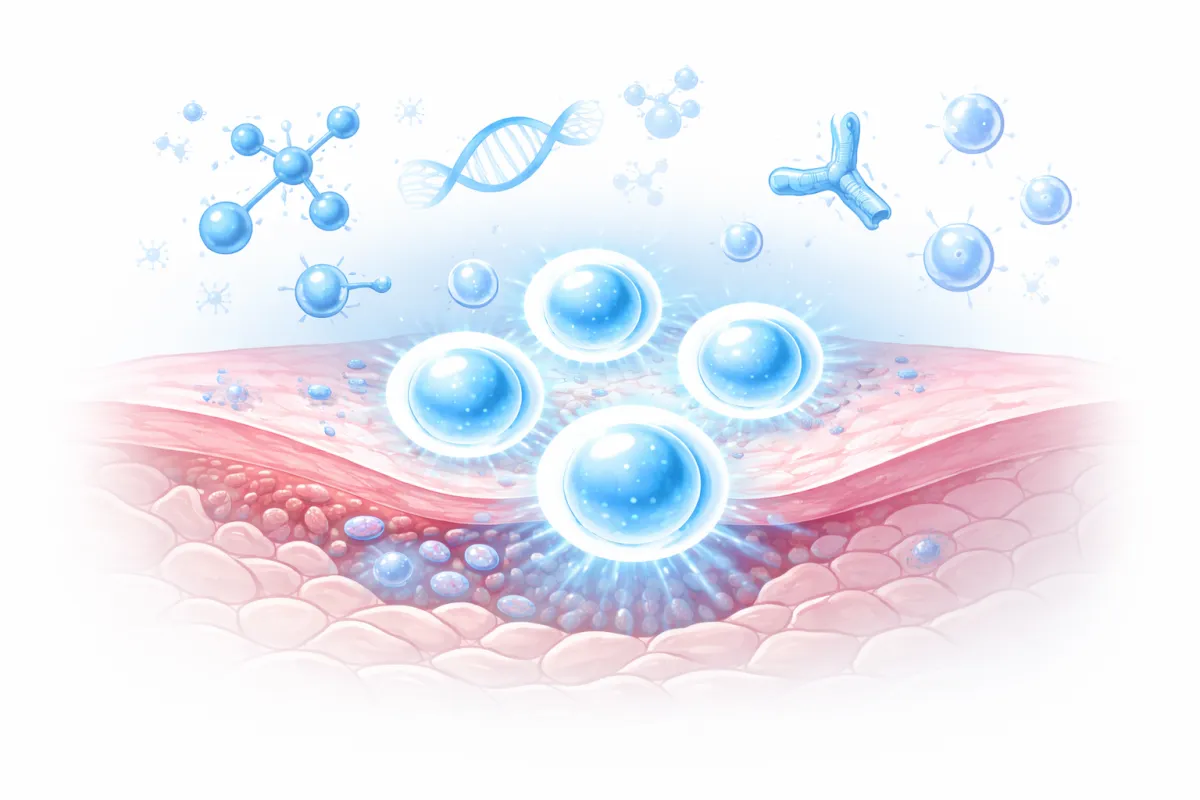
BPC-157: The Complete Guide to the Healing Peptide
Published: January 9, 2026 Category: Healing Peptides Author: The Peptide Index
AI SUMMARY
Definition: BPC-157 is a synthetic 15-amino acid peptide derived from a protein found in human gastric juice that promotes tissue repair through multiple biological pathways.
Primary Use: Accelerating healing of tendons, ligaments, muscles, and gut tissue through enhanced angiogenesis and growth factor activation.
Typical Timeline: Initial effects in 1-2 weeks; structural healing requires 4-8 weeks minimum.
Best For: Soft tissue injuries, post-surgical recovery, chronic tendon issues, gut healing protocols.
Not For: Those expecting overnight results, anyone seeking FDA-approved treatments, or competitive athletes subject to WADA testing.
What Is BPC-157?
BPC-157 (Body Protection Compound-157) is a 15-amino acid peptide fragment derived from a larger protein found naturally in human gastric juice. The "157" refers to its position in the amino acid sequence of the parent protein.
Unlike most peptides that target specific receptors, BPC-157 works through multiple mechanisms simultaneously. It promotes angiogenesis (new blood vessel formation), upregulates growth hormone receptors, reduces inflammatory cytokines, and modulates the nitric oxide system. This multi-pathway approach is why it affects so many different tissue types.
The peptide was first isolated and studied by Croatian researchers in the early 1990s. Over 100 studies have been published since then, though nearly all remain preclinical. A 2025 systematic review analyzed 36 studies spanning 1993-2024, confirming consistent mechanisms across decades of research.
BPC-157 is classified as a "cytoprotective" peptide, meaning it protects cells from damage and supports their repair. This distinguishes it from peptides that stimulate growth or modify hormone levels.
How BPC-157 Works
Understanding the mechanisms helps set realistic expectations for what BPC-157 can and cannot do.
Angiogenesis Acceleration
BPC-157 promotes formation of new blood vessels at injury sites. More blood flow means more oxygen, nutrients, and immune cells reaching damaged tissue. Research shows it upregulates VEGF (vascular endothelial growth factor) and other angiogenic factors. This is why injuries treated with BPC-157 often show faster resolution of swelling and bruising.
Growth Hormone Receptor Upregulation
Research published in Molecules showed BPC-157 enhances growth hormone receptor expression in tendon fibroblasts. When growth hormone binds to these upregulated receptors, it activates the JAK2 signaling pathway and stimulates collagen production. Your body becomes more responsive to its own healing signals rather than requiring external growth hormone.
Inflammatory Cytokine Reduction
BPC-157 decreases pro-inflammatory markers while promoting the shift from inflammatory to regenerative phases of healing. This creates an environment where tissue rebuilding occurs without excessive scar tissue formation. The anti-inflammatory effect is often the first thing users notice, typically within the first week.
Nitric Oxide System Modulation
The peptide interacts with the nitric oxide system, which regulates blood vessel dilation and tissue repair signaling. This contributes to systemic effects beyond just the injection site and explains why some benefits appear throughout the body even with localized injection.
The Construction Crew Analogy
Think of BPC-157 as building highways directly to a construction site and recruiting the repair crew. It doesn't do the building itself. It creates the infrastructure (blood vessels) and amplifies the signals (growth factor receptors) that allow your body's natural repair processes to work faster and more efficiently.
The Research Evidence
The BPC-157 literature contains over 100 published studies. Here's what the evidence actually shows, and what it doesn't.
What the Research Demonstrates
Musculoskeletal Outcomes (Preclinical)
A 2025 systematic review in the Orthopaedic Journal of Sports Medicine analyzed 36 studies from 1993-2024. In animal models, BPC-157 improved functional and structural outcomes in:
Tendon ruptures
Ligament tears
Muscle injuries
Bone fractures
Biomechanically, healed tendons showed increased load-to-failure and significantly higher functionality as measured by the Achilles Functional Index over 14 days.
Human Safety Data
A 2025 pilot study by Lee and Burgess tested intravenous BPC-157 in two healthy adults at doses up to 20mg. No adverse events or clinically meaningful changes were observed in vital signs, electrocardiograms, or laboratory markers. Plasma levels returned to baseline within 24 hours, confirming rapid clearance.
Human Efficacy Data (Limited)
In a case series, 7 of 12 patients with chronic knee pain reported relief lasting over six months after a single BPC-157 injection. This remains the only published human efficacy data for musculoskeletal applications.
Gastrointestinal Research
BPC-157 was originally studied for inflammatory bowel disease and gastric ulcers. Preclinical models showed improved outcomes in ulcer healing, anastomotic site repair, various GI fistulas, and NSAID-induced injury.
What the Research Does Not Show
No randomized, controlled human trials exist. The 2025 MDPI systematic review concluded that human evidence remains insufficient to establish safety or efficacy. Of 36 studies analyzed, 35 were preclinical and 1 was a small uncontrolled case series.
A Phase I clinical trial was registered in 2015 but was cancelled without published results.
Clinical Experience Data
Practitioner reports suggest approximately 80% of soft tissue injury cases show meaningful improvement with BPC-157 protocols. This observation comes from compiled case data, not controlled trials, but provides context for realistic expectations.
The Protocol
Protocols vary based on application. These ranges reflect commonly reported research parameters.
Standard Dosing
Dose: 250-500 mcg per day
Frequency: Once daily, or split into two doses (morning and evening)
Duration: 4-8 weeks for acute issues; up to 12 weeks for chronic conditions
Administration: Subcutaneous injection
Injection Site Strategy
For localized injuries, inject subcutaneously as close to the affected area as practical. BPC-157 demonstrates stronger local effects when administered near the injury site, though systemic benefits occur regardless of injection location.
For gut healing protocols, subcutaneous abdominal injection or oral administration are both used. Some research suggests the peptide remains active through the GI tract due to its stability, though oral bioavailability data in humans is limited.
Reconstitution
Mix with bacteriostatic water. Standard reconstitution uses 2mL of BAC water per 10mg vial, yielding 5mg/mL concentration.
At this concentration:
10 units on an insulin syringe = 500 mcg
5 units on an insulin syringe = 250 mcg
Store reconstituted peptide in the refrigerator. Stability is approximately 4-6 weeks when properly stored.
Protocol Summary
Parameter Standard Protocol Daily dose 250-500 mcg Frequency 1-2x daily Duration 4-8 weeks Injection Subcutaneous, near injury site Reconstitution 2mL BAC water per 10mg vial
What to Expect: Timeline
Setting accurate expectations prevents premature discontinuation.
Week 1-2
Inflammation reduction is typically the first noticeable change. Pain levels may decrease 20-30%. Sleep quality often improves as pain-related disruption decreases. These early effects reflect the anti-inflammatory mechanisms beginning to work, not structural healing.
Week 3-4
Functional improvements become measurable. Range of motion increases. Pain during movement decreases. This is when most users report the compound is clearly working. You may be able to resume activities that were previously painful.
Week 5-8
Structural healing occurs during this phase. Collagen remodeling takes time regardless of intervention. Users who stop at week 4 often miss the deeper tissue repair that BPC-157 supports during this window. Continue the full protocol even if symptoms have improved.
Beyond Week 8
Chronic issues may require extended protocols. Some practitioners report 12-week cycles for longstanding injuries. Results plateau eventually as the tissue reaches its healing capacity.
What Does Not Happen
Overnight healing
Complete reversal of severe structural damage
Regeneration of tissue that requires surgical intervention
Results in days rather than weeks
BPC-157 accelerates natural healing processes. It does not replace them.
Stacking Strategies
BPC-157 pairs effectively with other compounds depending on goals.
Injury Recovery Stack (Wolverine Protocol)
Purpose: Comprehensive soft tissue healing
Peptide Dose Frequency BPC-157 250-500 mcg Daily TB-500 2-5 mg 2x weekly (loading) TB-500 2 mg 1x weekly (maintenance)
Duration: 6-8 weeks
Rationale: BPC-157 builds blood vessels and handles local repair. TB-500 coordinates systemic healing and prevents adhesion formation. Think of BPC as the construction crew and TB-500 as the project manager coordinating the entire job.
Tissue Regeneration Stack
Purpose: Enhanced collagen rebuilding
Peptide Dose Frequency BPC-157 250-500 mcg Daily GHK-Cu 1-2 mg 3x weekly
Duration: 8-12 weeks
Rationale: GHK-Cu enhances collagen density and tissue remodeling. Combined with BPC-157's angiogenesis effects, this supports comprehensive tissue regeneration with improved structural integrity.
Gut Healing Protocol
Purpose: GI repair and inflammation reduction
Peptide Dose Frequency BPC-157 250-500 mcg Daily (oral or injectable) KPV 200-400 mcg Daily
Duration: 4-8 weeks
Rationale: KPV provides targeted anti-inflammatory effects in gut tissue. BPC-157 promotes mucosal healing and epithelial repair. This combination addresses both inflammation and structural repair.
Safety and Side Effects
BPC-157 has a favorable safety profile in available data, though human evidence remains limited.
Preclinical Safety
Animal studies across multiple species showed no adverse effects on organ systems at therapeutic doses. No toxicity was observed even at doses significantly higher than typical research protocols.
Human Safety Data
The 2025 pilot study showed no adverse events at IV doses up to 20mg, far exceeding typical subcutaneous protocols (250-500 mcg). Vital signs, cardiac function, liver enzymes, and kidney markers remained within normal ranges.
Commonly Reported Effects
Most users report no side effects. Some note:
Mild injection site reactions (redness, slight swelling) that resolve within hours
Occasional fatigue or headache, uncommon and typically transient
Increased dream vividness (anecdotal, mechanism unknown)
Contraindications
Active cancer or history of cancer (theoretical concern due to angiogenesis promotion)
Pregnancy or breastfeeding
Those taking medications that affect blood vessel formation or clotting
Drug Interactions
Avoid combining with NSAIDs during healing protocols. NSAIDs may counteract BPC-157's regenerative mechanisms by suppressing the inflammatory cascade that initiates repair. If pain management is needed, consider acetaminophen as an alternative.
Regulatory Status
Understanding the legal landscape prevents confusion.
FDA Status
BPC-157 is not FDA-approved for any indication. In 2023, the FDA placed BPC-157 on the Category 2 bulk drug substances list, meaning licensed compounding pharmacies cannot compound it for human use.
WADA Status
BPC-157 is prohibited under the World Anti-Doping Agency's S0 category (Non-Approved Substances). Athletes subject to drug testing should not use this compound.
Research Chemical Classification
BPC-157 is legally sold as a research chemical in the United States. Products labeled "for research purposes only" exist in a regulatory grey area. Possession is not illegal, as it is not a DEA-scheduled substance.
Quality Concerns
The unregulated market creates variability in product quality. Third-party testing and certificates of analysis are essential for verifying purity and correct peptide sequence.
Frequently Asked Questions
How quickly does BPC-157 work?
Anti-inflammatory effects begin within days. Measurable healing improvements typically appear by weeks 3-4. Structural tissue repair requires the full 6-8 week protocol.
Injectable or oral?
Injectable administration provides more reliable delivery. Oral BPC-157 may be effective for gut-specific applications due to the peptide's stability, but systemic effects are better achieved through injection.
Can I use BPC-157 long-term?
Extended use is common in clinical settings. Unlike receptor-targeted compounds, BPC-157 works through tissue repair mechanisms that do not typically require cycling.
Is BPC-157 legal?
BPC-157 is legal to possess as a research chemical. It cannot be prescribed by physicians or compounded by licensed pharmacies for human use.
Does injection site matter?
Yes, for localized injuries. BPC-157 shows stronger local effects when administered near the injury site. For systemic effects or gut healing, injection location is less critical.
Can I combine BPC-157 with TB-500?
Yes. This combination (often called the Wolverine Stack) is commonly used. The peptides work through complementary mechanisms and do not interfere with each other.
Trusted Sources
Quality verification matters for research peptides. These suppliers provide third-party testing and certificates of analysis.
Modern Aminos carries BPC-157 in standard vial sizes. They also offer a BPC-157/TB-500 Blend for combination protocols. Code "zach10" for 10% off.
Optimum Formula offers BPC-157 at 10mg concentration plus a BPC-157 + TB-500 blend for those running the Wolverine Stack. Code "BHACK" for 10% off.
Limitless Life Nootropics offers multiple BPC-157 formats including injectable, spray, and capsules. They also carry TB-500 for stacking. Code "BHACK" for 15% off.
LimitlessBioChem serves EU researchers with injectable and capsule options. Code "BHACK" for 10% off.
BioSLab serves Canadian researchers with 10mg and 5mg vials plus capsule form. Code "BHACK" for 10% off.
BioLongevity Labs carries BPC-157, TB-500, and pre-mixed BPC-157 + TB-500 blend. Code "BHACK" for 15% off.
Always verify certificate of analysis before use. Confirm peptide purity is 98% or higher and sequence matches the target compound.
Key Takeaways
BPC-157 accelerates natural healing through angiogenesis, growth factor upregulation, and inflammation reduction
Expect results in weeks, not days with structural healing requiring 6-8 weeks minimum
Injection near the injury site produces stronger local effects than distant injection
The Wolverine Stack (BPC-157 + TB-500) is the most common combination for comprehensive healing
No human clinical trials exist despite extensive preclinical research and practitioner experience
FDA Category 2 status means compounding pharmacies cannot legally produce BPC-157 for human use
Quality sourcing matters due to the unregulated research chemical market
Avoid NSAIDs during BPC-157 protocols as they may counteract healing mechanisms
Related Guides
Disclaimer: This content is for educational and research purposes only. Peptides discussed are not FDA-approved for human use. Nothing in this article constitutes medical advice. Consult qualified professionals for guidance.
Last updated: January 9, 2026
