BPC-157 vs TB-500 vs GHK-Cu: Which Healing Peptide Do You Actually Need?
These three peptides appear together so often that most people assume they do the same thing. They do not.
BPC-157, TB-500, and GHK-Cu each address tissue repair through fundamentally different mechanisms. Understanding those differences determines whether you get meaningful results or waste months running the wrong compound for your situation.
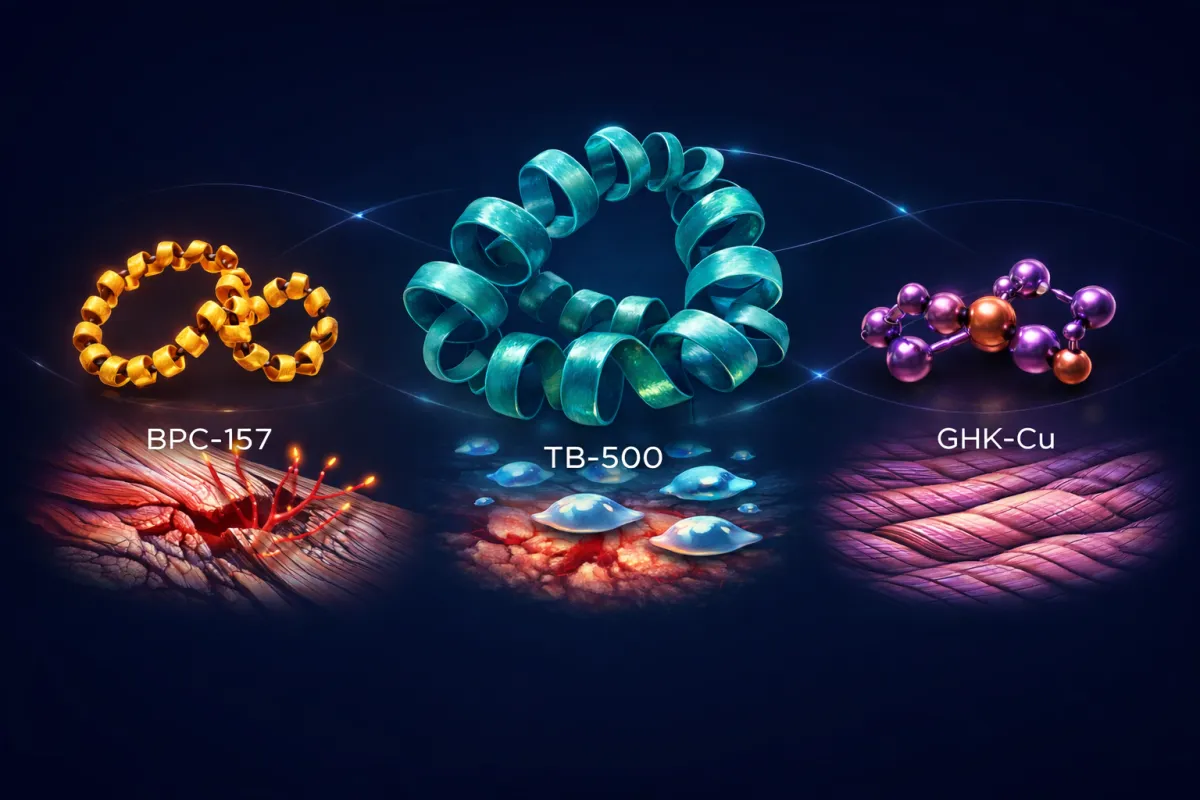
Think of it like a construction site. BPC-157 is the repair crew that fixes damaged structures and restores plumbing. TB-500 is the general contractor coordinating workers, materials, and logistics to the job site. GHK-Cu is the architect who redesigns and remodels the building after the emergency repairs are done.
Send the architect when you need the repair crew and nothing happens. Send the repair crew when you need the architect and you get patched walls instead of proper renovation. Match the right peptide to the right problem and you get results that compound over time.
This guide breaks down exactly what each peptide does, where each one excels, where each one falls short, and how to decide which one your situation actually requires.
KEY FACTS
BPC-157 is a 15 amino acid gastric peptide that accelerates tissue repair through angiogenesis, growth factor upregulation, and nitric oxide pathway modulation. Best for tendon, ligament, gut, and organ healing.
TB-500 is a 43 amino acid fragment of Thymosin Beta-4 that promotes healing through actin regulation, cell migration, and anti-inflammatory signaling. Best for muscle injuries, systemic inflammation, and cardiac support.
GHK-Cu is a copper-binding tripeptide that remodels tissue architecture through gene expression modulation, collagen synthesis, and stem cell recruitment. Best for skin rejuvenation, cosmetic healing, and anti-aging applications.
For acute injuries: BPC-157 + TB-500 is the primary combination
For skin and anti-aging: GHK-Cu is the clear leader
For comprehensive healing: All three together (the GLOW protocol) address the full spectrum from emergency repair to architectural remodeling
Understanding the Three Mechanisms
Before comparing these peptides head to head, you need to understand that they operate at different stages of the healing process. This is not a matter of one being better than another. It is a matter of what your body needs right now.
BPC-157: The Repair Crew
BPC-157 is a synthetic pentadecapeptide derived from a larger Body Protection Compound found naturally in human gastric juice. Its 15 amino acid sequence (Gly-Glu-Pro-Pro-Pro-Gly-Lys-Pro-Ala-Asp-Asp-Ala-Gly-Leu-Val) has been studied for over 30 years, primarily in animal models.
Clinical experience positions BPC-157 as what one practitioner calls "the forever peptide" because it can be run at maintenance doses indefinitely without cycling. It operates through five primary mechanisms:
Angiogenesis. BPC-157 promotes new blood vessel formation through VEGF upregulation. More blood vessels means more nutrients, oxygen, and healing factors delivered to damaged tissue. This is why injuries heal faster: the supply chain improves.
Growth Factor Upregulation. The peptide increases expression of VEGF, EGF, FGF, and upregulates growth hormone receptors specifically at injury sites. This creates a concentrated healing environment around damaged tissue.
Nitric Oxide Pathway Modulation. BPC-157 has profound effects on nitric oxide signaling through eNOS expression. This regulates blood flow, inflammation response, and cardiovascular function. Many of BPC-157's protective effects trace back to this pathway.
Gut-Brain Axis Regulation. BPC-157 interacts with the vagus nerve, supporting bidirectional communication between gut and brain. It seals leaks in the gut lining, stops endotoxins from flooding the bloodstream, and fixes tight junctions in the intestinal wall. This is why athletes see benefits beyond injury healing.
Collagen Formation. BPC-157 enhances collagen synthesis and proper alignment, promoting Type I collagen in tendons and ligaments while improving tensile strength and reducing scar tissue formation.
Where BPC-157 Excels: Tendon and ligament repair, gut healing (ulcers, IBD, leaky gut), organ protection, neuroprotection, post-surgical recovery.
Where BPC-157 Falls Short: Cosmetic skin improvements, large-scale tissue remodeling, muscle flexibility and mobility.
TB-500: The General Contractor
TB-500 is a synthetic version of a 43 amino acid fragment of Thymosin Beta-4, a naturally occurring protein involved in cellular development and tissue repair. It operates through a fundamentally different mechanism than BPC-157.
Practitioners describe TB-500 through four cellular commands:
"Move." TB-500 drives cellular migration to injury sites. Without this command, repair cells sit idle instead of traveling to where damage occurred. This chemotactic function is critical in early wound healing phases.
"Grow." The peptide promotes angiogenesis, creating new blood vessel networks to support healing tissue. This overlaps with BPC-157 but works through different signaling pathways.
"Calm Down." TB-500 downregulates NF-kB and increases IL-10, turning off inflammatory cascading within 45 minutes in some research models. This anti-inflammatory effect reduces secondary damage from the immune response itself.
"Rebuild." TB-500 binds actin monomers and directs cytoskeletal reconstruction. Actin is the scaffolding that gives cells their shape, strength, and ability to move. TB-500 acts as the foreman of the actin construction crew, directing cellular reconstruction from the ground up.
The cardiac applications are often overlooked. Research shows TB-500 promotes angiogenesis in damaged heart tissue with studies documenting 43% improvement in ejection fraction post-myocardial infarction. Corneal repair studies demonstrate complete epithelial regeneration in 72 hours.
Where TB-500 Excels: Muscle tears and strains, systemic inflammation reduction, cardiac protection and repair, flexibility and mobility improvement, large-area tissue damage.
Where TB-500 Falls Short: Specific tendon repair (BPC-157 is more targeted), gut healing (minimal GI data), cosmetic applications, gene expression modulation.
GHK-Cu: The Architect
GHK-Cu is a naturally occurring copper-binding tripeptide (glycyl-L-histidyl-L-lysine) found in human plasma, saliva, and urine. Plasma levels drop from approximately 200 ng/mL at age 20 to just 80 ng/mL by age 60.
GHK-Cu operates at a fundamentally different level than BPC-157 or TB-500. Rather than accelerating existing healing processes, it reprograms cellular behavior toward regeneration.
Gene Expression Modulation. GHK-Cu influences over 4,000 human genes. It upregulates 84 genes associated with DNA repair, 10 caspase genes involved in programmed cell death of damaged cells, and protective enzymes like SOD. It downregulates pro-inflammatory cytokines including TNF-alpha and IL-6. This is not surface-level healing. It is reprogramming cellular behavior.
Collagen Architecture. Unlike standard wound healing that produces disorganized scar tissue, GHK-Cu promotes organized collagen deposition resembling undamaged tissue. It stimulates metalloproteinases and their inhibitors simultaneously, meaning it removes damaged proteins while laying down new structural components. This is controlled remodeling, not blind construction.
Copper Delivery. The copper ion bound to GHK serves critical functions. Copper is essential for enzymes involved in collagen synthesis, elastin formation, and antioxidant defense. GHK delivers copper precisely where regeneration is needed while preventing copper toxicity.
Stem Cell Recruitment. GHK-Cu attracts stem cells to damaged areas and promotes their differentiation into functional tissue. This regenerative signaling contributes to effects beyond simple wound healing.
Where GHK-Cu Excels: Skin rejuvenation and anti-aging, cosmetic wound healing, hair growth and follicle stimulation, collagen and elastin restoration, long-term tissue quality improvement.
Where GHK-Cu Falls Short: Acute injury repair (too slow for emergencies), gut healing (no significant GI data), tendon-specific repair, systemic anti-inflammatory effects.
Head-to-Head Comparison
Injury Type Matching
Tendon or Ligament Injury: BPC-157 is the clear first choice. It specifically enhances tendon fibroblast growth, upregulates growth hormone receptors at injury sites, and promotes organized collagen formation in connective tissue. TB-500 as a complement accelerates cell migration to the injury site. GHK-Cu is secondary here.
Muscle Tear or Strain: TB-500 leads. Its actin regulation and cell migration functions directly address muscle fiber reconstruction. BPC-157 provides complementary blood vessel formation and growth factor support. GHK-Cu contributes less to acute muscle repair.
Chronic Non-Healing Wound: All three together. BPC-157 addresses blood vessel formation and growth factors. TB-500 coordinates cellular migration and reduces inflammation preventing healing. GHK-Cu remodels tissue architecture and promotes quality healing rather than scar formation.
Post-Surgical Recovery: BPC-157 + TB-500. BPC-157 accelerates tissue repair and protects organs from surgical stress. TB-500 reduces inflammation and promotes cell migration for faster closure. Add GHK-Cu after initial healing for scar minimization.
Skin Aging or Cosmetic Goals: GHK-Cu dominates. Its gene expression modulation, collagen remodeling, elastin restoration, and stem cell recruitment address skin quality at the cellular level. BPC-157 and TB-500 offer minimal cosmetic benefit.
Gut Issues (IBD, Leaky Gut, Ulcers): BPC-157 alone. It is derived from gastric juice, specifically targets gut tight junctions, and has the strongest GI research of any peptide. TB-500 and GHK-Cu lack significant gut data.
Hair Loss: GHK-Cu leads. It stimulates hair follicle stem cells, increases VEGF for follicle blood flow, and prevents follicle miniaturization. Research shows comparable efficacy to 5% minoxidil. BPC-157 and TB-500 are not primary hair loss interventions.
Cardiac Support: TB-500 is the standout. Research documenting 43% ejection fraction improvement post-MI and specific cardiac tissue angiogenesis makes it the clear choice. BPC-157 provides cardiovascular protection through nitric oxide modulation. GHK-Cu has limited cardiac data.
Speed of Action
Fastest: BPC-157. Effects begin within days for gut applications and within 1 to 2 weeks for injury healing. Daily dosing maintains consistent therapeutic levels due to shorter half-life.
Moderate: TB-500. Loading phase of 2 to 4 weeks required before maintenance. Longer half-life means less frequent dosing but slower initial onset. Systemic anti-inflammatory effects can be noticed within the first week.
Slowest: GHK-Cu. Tissue remodeling and gene expression changes take 4 to 8 weeks to become apparent. Cosmetic improvements typically require 30 or more days. This is not a weakness. Remodeling takes longer than repair because it produces higher-quality results.
Research Base
Strongest: BPC-157. Over 30 years of research across hundreds of studies, primarily animal models. One pilot human study in interstitial cystitis (2024). Croatian researchers have built the most extensive evidence base of any healing peptide.
Moderate: GHK-Cu. Strong evidence for skin applications, gene expression, wound healing, and hair growth. Well-characterized molecular mechanisms. Clinical data in dermatological applications.
Growing: TB-500. Strong cardiac and wound healing data. The parent compound Thymosin Beta-4 has extensive clinical research. TB-500 specifically has less published data but strong practitioner experience.
Practical Protocols
BPC-157
Standard Healing Protocol: 250 to 500 mcg subcutaneously once daily for 4 to 8 weeks. Inject near injury site for local effect or abdomen for systemic distribution.
Maintenance Protocol: 250 mcg daily ongoing. Can be run indefinitely without cycling based on clinical experience.
Aggressive Healing: 500 mcg twice daily (morning and evening) for 2 to 4 weeks, then reduce to standard dosing.
Half-Life: Hours. Requires daily dosing for consistent levels.
TB-500
Loading Phase: 2 to 2.5 mg twice weekly for 4 to 6 weeks. This front-loads the system and establishes therapeutic levels.
Maintenance Phase: 2 mg once weekly after loading phase completes.
Total Course: 10 to 12 weeks minimum for most applications.
Half-Life: Days. Less frequent dosing required compared to BPC-157.
Critical Note: TB-500 requires substantial doses to work. Micro-dosing at 0.5 mg is insufficient. Clinical protocols call for 5 to 10 mg per week during loading.
GHK-Cu
Standard Protocol: 1 to 2 mg subcutaneously daily for 8 to 12 weeks.
Maintenance and Anti-Aging: 300 mcg to 1 mg daily, 3 to 5 times weekly.
Topical Application: Can be applied directly to skin or scalp for localized effects. Often combined with injectable for systemic plus local approach.
Duration: 6 to 12 months minimum for cosmetic and anti-aging goals. Hair growth requires extended protocols.
When to Use Each One Alone
Choose BPC-157 Alone When:
You have a specific tendon or ligament injury. You are dealing with gut issues (ulcers, IBD, leaky gut, SIBO). You need organ protection during medication use (particularly NSAIDs). You want a single daily peptide for general tissue maintenance. Budget is limited and you need one peptide to cover the most ground.
Choose TB-500 Alone When:
You have a muscle tear or strain. Systemic inflammation is your primary concern. You need cardiac support or recovery. Flexibility and mobility are the main goals. You prefer less frequent injections (twice weekly vs daily).
Choose GHK-Cu Alone When:
Skin quality, anti-aging, or cosmetic results are the primary goal. Hair growth and follicle health are the focus. You want gene-level tissue remodeling rather than acute repair. You are in a maintenance phase after acute healing is complete. Long-term tissue quality matters more than speed of healing.
When to Combine Them
The Wolverine Stack (BPC-157 + TB-500)
The most common healing combination. BPC-157 handles repair (blood vessels, growth factors, collagen) while TB-500 handles logistics (cell migration, inflammation control, cytoskeletal reconstruction).
Protocol: BPC-157 250 to 500 mcg daily + TB-500 2 to 2.5 mg twice weekly during loading, then TB-500 2 mg weekly for maintenance. Duration 8 to 12 weeks.
Best for: Acute injuries, post-surgical recovery, chronic pain, athletic recovery.
Important: Run these in separate vials. Despite convenience, blended vials lock you into fixed ratios and peptides may degrade each other in the same solution. Separate vials give you dosing control.
The GLOW Protocol (BPC-157 + TB-500 + GHK-Cu)
The full-spectrum approach. All three peptides address different stages of the healing cascade, from emergency repair through architectural remodeling.
The established ratio is 5:1:1 (GHK-Cu : TB-500 : BPC-157) in commercial blends. Individual dosing allows for customization based on primary goals.
Protocol: BPC-157 250 to 500 mcg daily + TB-500 2 mg twice weekly + GHK-Cu 1 to 2 mg daily. Duration 8 to 12 weeks for healing, ongoing for anti-aging.
Best for: Comprehensive healing with cosmetic considerations, post-surgical recovery with scar minimization, chronic wounds, anti-aging with injury recovery.
The Skin Stack (GHK-Cu + BPC-157)
Pairs GHK-Cu's collagen remodeling with BPC-157's deep tissue regeneration.
Protocol: GHK-Cu 1 to 2 mg daily (injectable + topical) + BPC-157 250 mcg daily. Duration 8 to 12 weeks minimum.
Best for: Skin rejuvenation with tissue support, scar revision, post-procedure healing (microneedling, laser).
Cost Comparison
Budget matters. Here is the realistic cost breakdown per month at standard dosing:
BPC-157: Most affordable. At 250 to 500 mcg daily from a 5 to 10 mg vial, expect 10 to 20 days per vial. Monthly cost approximately $40 to $80.
TB-500: Moderate. At 4 to 5 mg weekly from 10 mg vials, expect 2 weeks per vial during loading. Monthly cost approximately $60 to $120 during loading, less during maintenance.
GHK-Cu: Most expensive at higher doses. At 1 to 2 mg daily from 50 to 100 mg vials, monthly cost approximately $40 to $100 depending on source and dosing.
Full GLOW Protocol: Combined monthly cost approximately $140 to $300 during loading phases.
Budget Recommendation: If you can only afford one, BPC-157 covers the most ground for most situations. Add TB-500 for significant injuries. Add GHK-Cu when acute healing completes and remodeling becomes the priority.
Common Mistakes
Running GHK-Cu for acute injuries. GHK-Cu is a remodeling peptide, not an emergency repair peptide. Using it alone for a fresh tendon tear misses the acute healing window. Start with BPC-157 and TB-500, then transition to GHK-Cu for tissue quality.
Under-dosing TB-500. The most common TB-500 mistake. Micro-doses of 0.5 mg accomplish nothing. Loading phase requires 5 to 10 mg per week. If the dose feels small, it probably is.
Skipping the loading phase for TB-500. TB-500 requires front-loading to establish therapeutic levels. Starting at maintenance doses means you never reach effective concentrations.
Using blended vials for all three. Convenience comes at the cost of dosing control and potentially peptide stability. Run separate vials whenever possible.
Expecting BPC-157 results from GHK-Cu timelines. BPC-157 shows effects in days to weeks. GHK-Cu remodeling takes weeks to months. Different peptides, different timescales. Patience with GHK-Cu pays off in tissue quality.
Forgetting that oral BPC-157 does not work. Despite marketing claims, oral BPC-157 has essentially zero bioavailability. Injectable is the only effective method. Clinical experience is clear on this point.
Frequently Asked Questions
Can I use all three at the same time?
Yes. They work through different mechanisms and complement rather than compete with each other. The GLOW protocol (all three combined) is a well-established approach in clinical settings.
Which one should I start with if I have never used peptides?
BPC-157. It has the longest research history, simplest dosing protocol (once daily), and broadest application range. It is the most forgiving for beginners and produces noticeable results within the first few weeks.
Do I need to cycle any of these?
BPC-157 can run indefinitely at maintenance doses. TB-500 should be cycled (loading then maintenance, with breaks between courses). GHK-Cu can run long-term for anti-aging but benefits from periodic breaks of 2 to 4 weeks every 3 months.
Can I inject them all at the same time?
Yes, but use separate syringes from separate vials. You can inject all three at different sites during the same session.
How do I know when to transition from repair to remodeling?
When acute pain and inflammation resolve and functional recovery begins. This is typically 4 to 6 weeks into a BPC-157 and TB-500 protocol. At this point, GHK-Cu becomes more valuable than additional acute repair signaling.
Are the GLOW and KLOW blends worth it?
GLOW (BPC-157 + TB-500 + GHK-Cu) and KLOW (GLOW + KPV) offer convenience. They are worth it for maintenance and general use. For targeted healing requiring dose adjustments, individual vials provide better control.
Trusted Sources
Quality matters with research peptides. Third-party testing and proper handling make the difference between effective research and wasted effort.
All seven vendors below carry BPC-157, TB-500, and GHK-Cu individually. Most also offer pre-made GLOW (BPC-157 + TB-500 + GHK-Cu) and KLOW (GLOW + KPV) blends for convenience.
Modern Aminos | Code: zach10 (10% off) | Carries all three individually + KLOW blend
Optimum Formula | Code: BHACK (10% off) | BPC-157 + TB-500 blend, GLOW, and KLOW blends
ResearchChemHQ | Code: BHACK | All three individually + GLO and KLOW blends
LimitlessBioChem EU | Code: BHACK (10% off) | All three individually + GLOW blend (EU shipping)
BioSLab Canada | Code: BHACK (10% off) | All three individually + GLOW blend (Canadian shipping)
Limitless Life Nootropics | Code: BHACK (15% off) | BPC-157, TB-500, and GHK-Cu individually (multiple forms including sprays and capsules)
BioLongevity Labs | Code: BHACK (15% off) | All three individually + GLOW and KLOW blends
For complete vendor comparison and product-specific links: biohackblueprint.io
Final Thoughts
BPC-157, TB-500, and GHK-Cu are not interchangeable. They are complementary.
BPC-157 repairs. TB-500 coordinates. GHK-Cu remodels. Each excels where the others fall short.
The smartest approach is sequential: start with the peptide that matches your immediate need, then layer in complementary compounds as your situation evolves. A fresh injury gets BPC-157 and TB-500. A healed but scarred area gets GHK-Cu. Ongoing maintenance gets whatever combination keeps you functional and resilient.
Do not overcomplicate this. Identify your problem. Match it to the mechanism. Run the protocol. Assess results. Adjust.
Which of these three are you currently using or considering? What is the specific injury or goal driving your decision? Share your situation in the comments and the community can help you match the right peptide to your needs.
Disclaimer: This content is for educational and research purposes only. Peptides are not approved for human use. Nothing here is medical advice. Consult a qualified professional for personalized guidance.
