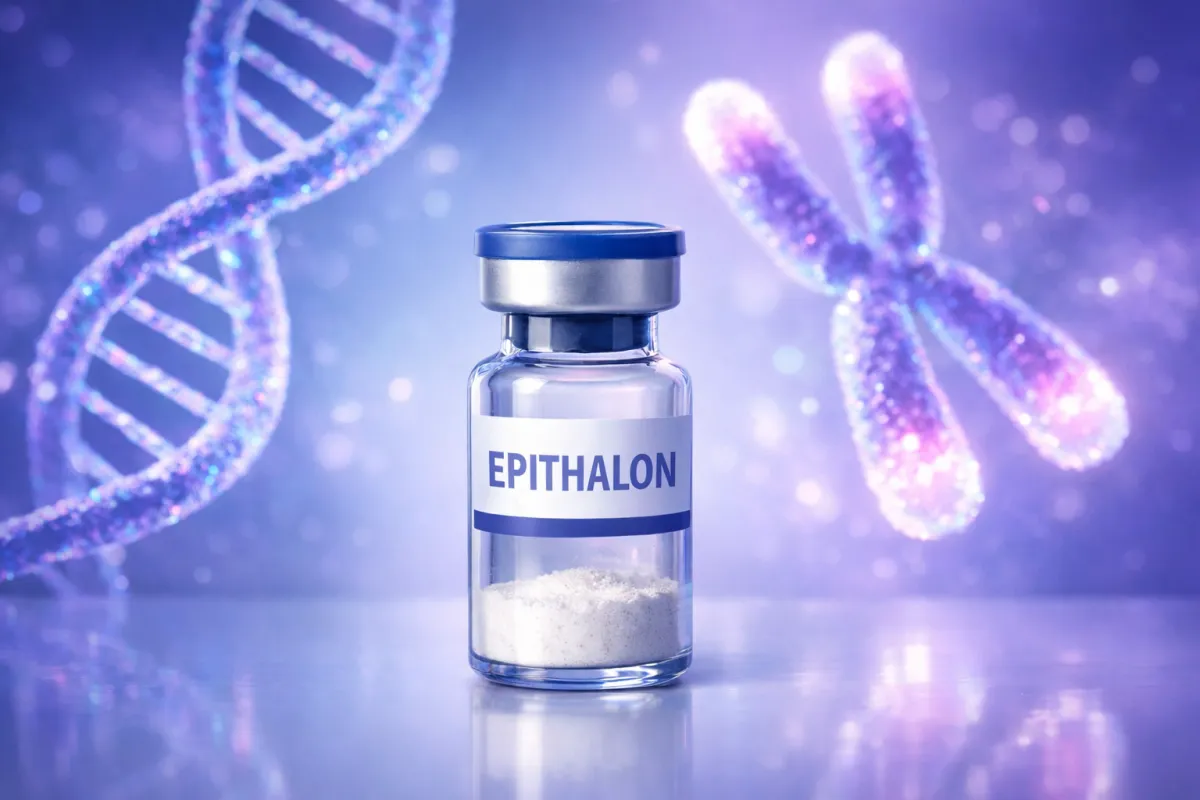
Epithalon: Complete Guide to the Telomere Reset Peptide
Epithalon: Complete Guide to the Telomere Reset Peptide
The longevity peptide that targets the fundamental mechanism of cellular aging.
AI SUMMARY
Definition: Epithalon is a synthetic tetrapeptide (Ala-Glu-Asp-Gly) that activates telomerase, the enzyme responsible for rebuilding telomeres at the ends of chromosomes.
Primary Use: Longevity optimization, cellular anti-aging, telomere maintenance, circadian rhythm regulation, and pineal gland support.
Typical Timeline: 10-20 day cycles, repeated 2-3 times per year. Subjective effects (sleep, energy) within 1-2 weeks; cellular effects require months to years.
Best For: Adults 40+ focused on long-term longevity, those with accelerated aging markers, or anyone serious about cellular-level anti-aging.
Not For: Those expecting immediate subjective effects, anyone with active cancer, or people unwilling to commit to cyclical long-term protocols.
The Cellular Aging Problem
Every time your cells divide, something gets lost.
At the ends of your chromosomes sit protective caps called telomeres. These repetitive DNA sequences (TTAGGG) protect your genetic material during cell division. But with each division, telomeres shorten slightly. Eventually, they reach a critical length called the Hayflick limit, and the cell can no longer divide. It becomes senescent or dies.
This is one of the fundamental mechanisms driving biological aging.
Epithalon targets this process directly. Rather than addressing downstream symptoms of aging, it goes to the source: reactivating the enzyme that rebuilds telomeres.
Think of your cells as having a biological countdown clock built into their DNA. Epithalon may be able to reset that clock.
What Is Epithalon
Epithalon (also spelled Epitalon) is a tetrapeptide consisting of four amino acids: Alanine-Glutamic Acid-Aspartic Acid-Glycine.
It was synthesized to mimic epithalamin, a naturally occurring peptide secreted by the pineal gland. Your body produces very small amounts of this peptide, but production declines dramatically with age.
Professor Vladimir Khavinson and his team at the St. Petersburg Institute of Bioregulation and Gerontology developed Epithalon in the 1990s. It has been studied extensively in Russia for over 30 years, though Western research is now accelerating.
In 2017, researchers confirmed Epithalon exists naturally in human pineal gland extracts. This explains why the synthetic version has similar properties to the natural peptide your body already produces, just in declining quantities as you age.
How Epithalon Works
Mechanism 1: Telomerase Activation
Telomerase is the enzyme that adds telomeric repeats back to chromosome ends. In most adult somatic cells, telomerase activity is extremely low or absent. This is why telomeres shorten with age.
Epithalon reactivates telomerase expression in somatic cells, allowing telomere regeneration even in cells that had lost this capacity.
A 2025 study published in Biogerontology demonstrated that Epithalon increases telomere length in both normal and cancer cell lines. The research showed dose-dependent telomere extension through both telomerase upregulation AND alternative lengthening of telomeres (ALT) pathways.
This dual mechanism is significant. It means Epithalon doesn't rely on a single pathway to extend telomeres.
Mechanism 2: Gene Expression Modulation
Epithalon doesn't just activate telomerase. It influences broader patterns of gene expression related to aging.
By binding to promoter regions and loosening chromatin structure, Epithalon may restore more youthful gene expression patterns. Studies show it can activate chromatin in aged cells, potentially reversing some epigenetic changes associated with aging.
Mechanism 3: Pineal Gland Regulation
Epithalon normalizes pineal gland function, which has downstream effects on melatonin production, circadian rhythm, and hormone balance.
Clinical research shows Epithalon restores melatonin secretion in both aged monkeys and humans. This explains why improved sleep quality is often the first subjective effect users notice.
Mechanism 4: Antioxidant Enhancement
Research shows Epithalon increases the activities of antioxidant enzymes including superoxide dismutase, glutathione peroxidase, and glutathione-S-transferase.
By boosting intrinsic antioxidant defenses through Nrf2 activation, Epithalon reduces oxidative damage markers and supports mitochondrial integrity.
Research Evidence
Human Studies
Russian clinical trials spanning decades have demonstrated benefits in elderly individuals with cardiovascular and metabolic disease. Documented improvements include immune function, sleep quality, cardiovascular markers, and metabolic parameters.
A 2024 case study published in the Journal of Restorative Medicine documented a 79-year-old male treated with Epithalon (plus other interventions) whose biological age reduced by 7.9 years and telomere length increased from 6.45 to 6.59 kb over 16 months.
Human clinical studies show both Epithalon and its precursor epithalamin significantly increased telomere lengths in blood cells of patients ages 60-65 and 75-80.
2025 Research Highlights
The most significant 2025 finding: Epithalon increases telomere length in human cell lines through both telomerase upregulation and ALT pathway activation. Telomere elongation was sufficient to surpass the Hayflick limit in human fetal fibroblast cells, extending their replicative potential beyond normal termination.
A 2025 study also demonstrated Epithalon stimulates telomerase activity in bovine cumulus cells, enhanced mitochondrial health via JC-1 staining, and reduced intracellular reactive oxygen levels.
Animal Studies
Animal research consistently shows Epithalon extends lifespan in mice and rats by 20-30%, especially those predisposed to rapid aging, without inducing tumor growth.
Studies demonstrate improved regenerative capacity, enhanced stress resistance, reduced age-related pathology, and restored immune function in aged animals.
One study found Epithalon significantly reduced chromosomal aberrations in aging mice, consistent with telomere length increases.
The Protocol
Standard Protocol
Dose: 1-2 mg daily
Duration: 10-20 consecutive days
Administration: Subcutaneous injection
Cycling: 2-3 times per year (not continuous use)
Timing: Morning administration aligns with circadian rhythms
Reconstitution
For a 10mg vial:
Add 2mL bacteriostatic water = 5 mg/mL concentration
1 mg dose = 0.2 mL (20 units on insulin syringe)
2 mg dose = 0.4 mL (40 units on insulin syringe)
Why Cycling Matters
Epithalon is used in short-term cycles rather than continuous administration. The goal is a "reset effect" on cellular and circadian function, not daily maintenance.
The standard pattern: 10-20 days on, then 3-6 months off. Repeat 2-3 times annually.
This cycling approach mimics how the body naturally produces epithalamin in pulses rather than continuously.
Storage
Lyophilized powder: Room temperature or refrigerated, protected from light
Reconstituted: Refrigerate, use within 30 days
What to Expect
Week 1-2:
Improved sleep quality (often the first noticeable effect)
Enhanced dream vividness
Potential increase in energy and alertness
Week 2-4:
Continued sleep improvements
Possible skin quality enhancement (anecdotal)
Immune resilience may improve
Month 1-3 (Post-Cycle):
Cellular aging effects not subjectively noticeable
Benefits theoretically continue as telomere changes persist
Some report sustained sleep improvements
Long-Term (6-12+ Months):
Cellular effects require telomere testing to confirm
Cumulative benefits hypothesized with repeated cycles
Biological age reduction documented in case studies
Important: Unlike peptides with immediate subjective effects (PT-141, Semax), Epithalon's primary benefits occur at the cellular level. Don't expect dramatic overnight changes. This is long-term cellular maintenance.
Who Benefits Most
Ideal Candidates:
Adults 40+ focused on longevity optimization
Those with early aging biomarkers or accelerated biological age
People serious about cellular-level anti-aging
Anyone committed to long-term cyclical protocols
Those comfortable with research-stage interventions
When Practitioners Recommend Starting: Many providers begin recommending Epithalon around age 40-45, or earlier for those under high stress or with accelerated aging markers.
Common Mistakes
Expecting immediate results: This isn't a performance peptide. Cellular aging effects take months to years. If you need immediate subjective feedback, track sleep quality during your cycle.
Using continuously instead of cycling: Continuous use defeats the purpose. The reset mechanism works through cyclical administration. Stick to 10-20 days on, months off.
Not tracking biomarkers: Without telomere testing or biological age markers, you're flying blind. Consider baseline testing before your first cycle and follow-up testing 6-12 months later.
Stopping after one cycle: Longevity is a long game. One cycle provides minimal data. Commit to at least 2-3 cycles annually for meaningful assessment.
Safety Considerations
Epithalon has an excellent safety profile across 30+ years of Russian research and clinical use.
Documented Side Effects (Rare):
Injection site reactions (mild, dose-dependent)
Headache (uncommon)
Fatigue during initial days (rare)
The Cancer Question:
The most common concern: Does activating telomerase increase cancer risk?
The evidence suggests no. Animal studies show Epithalon actually reduced spontaneous tumors and metastases in mice predisposed to cancer. The 2025 research showing Epithalon works through BOTH telomerase and ALT pathways may explain this. The peptide appears to support healthy cell maintenance without promoting malignant growth.
That said, those with active cancer or recent cancer history should avoid Epithalon until more human data exists.
Contraindications:
Active or recent cancer
Pregnancy or breastfeeding
Children under 18
Autoimmune conditions (use caution, consult provider)
Not FDA Approved: Epithalon is not FDA-approved for any indication. It remains a research compound. This information is for educational purposes only.
Stacking Strategies
Longevity Foundation Stack:
Epithalon (telomere maintenance)
MOTS-C (mitochondrial function)
NAD+ (cellular energy)
This addresses multiple hallmarks of aging simultaneously.
Sleep Optimization Stack:
Epithalon (circadian regulation)
DSIP (sleep architecture)
Pinealon (pineal support)
For those prioritizing sleep quality alongside longevity.
Comprehensive Anti-Aging Stack:
Epithalon (telomeres)
BPC-157 (systemic repair)
GHK-Cu (tissue regeneration)
Thymosin Alpha-1 (immune optimization)
The practitioner-recommended longevity protocol from clinical experience.
Trusted Sources
Quality and purity matter for longevity peptides. These suppliers provide third-party tested research compounds:
US Suppliers:
Modern Aminos (Code: zach10 for 10% off)
Optimum Formula (Code: BHACK for 10% off)
ResearchChemHQ (Code: BHACK)
Limitless Life Nootropics (Code: BHACK for 15% off)
BioLongevity Labs (Code: BHACK for 15% off)
Canadian Suppliers:
BioSLab (Code: BHACK for 10% off)
European Suppliers:
LimitlessBioChem (Code: BHACK for 10% off)
Always verify certificates of analysis before purchasing longevity compounds.
Frequently Asked Questions
How do I know if Epithalon is working? Track sleep quality during your cycle (most noticeable short-term effect). For cellular effects, consider telomere testing or biological age testing (TruAge, etc.) at baseline and 6-12 months later.
What age should I start? Most practitioners recommend starting around 40-45, or earlier if you have accelerated aging markers, high stress, or family history of age-related diseases.
Can I use Epithalon year-round? No. Cyclical use is essential. 10-20 days on, 3-6 months off, repeated 2-3 times yearly. Continuous use may reduce effectiveness.
Is it safe with other peptides? Yes. Epithalon stacks well with most peptides. Common combinations include MOTS-C, NAD+, BPC-157, and Thymosin Alpha-1.
Does it cause cancer? Current evidence suggests no. Animal studies show reduced tumor incidence. However, those with active cancer should avoid until more human data exists.
Injectable only or are there other forms? Subcutaneous injection is standard. Some vendors offer oral or nasal versions, but bioavailability data for these routes is limited. Injectable remains the research-validated approach.
How much does a year of Epithalon cost? Roughly $200-600 annually depending on dosing and vendor, making it one of the more affordable longevity interventions.
Will I feel different immediately? Possibly improved sleep within the first week. But the primary benefits (telomere maintenance, cellular aging) occur at levels you won't subjectively feel. This is long-term investment, not immediate gratification.
The Bottom Line
Epithalon represents a fundamentally different approach to anti-aging. Rather than treating symptoms or optimizing metabolism, it targets the cellular countdown clock encoded in your DNA.
The research is compelling: telomerase activation, telomere elongation, improved sleep, enhanced antioxidant capacity, and lifespan extension in animal models. The 2025 data showing dual pathway activation (telomerase + ALT) strengthens the mechanistic case.
Is it proven in humans over decades? Not yet. The long-term human data is still accumulating.
But for those serious about longevity optimization, Epithalon offers something rare: a direct intervention on one of the fundamental mechanisms of cellular aging.
The question isn't whether aging matters. The question is whether you're willing to invest in slowing it at the cellular level.
Related Guides:
Disclaimer: This content is for educational and research purposes only. Peptides are not approved for human use. Nothing here is medical advice. Consult a qualified professional for personalized guidance.
