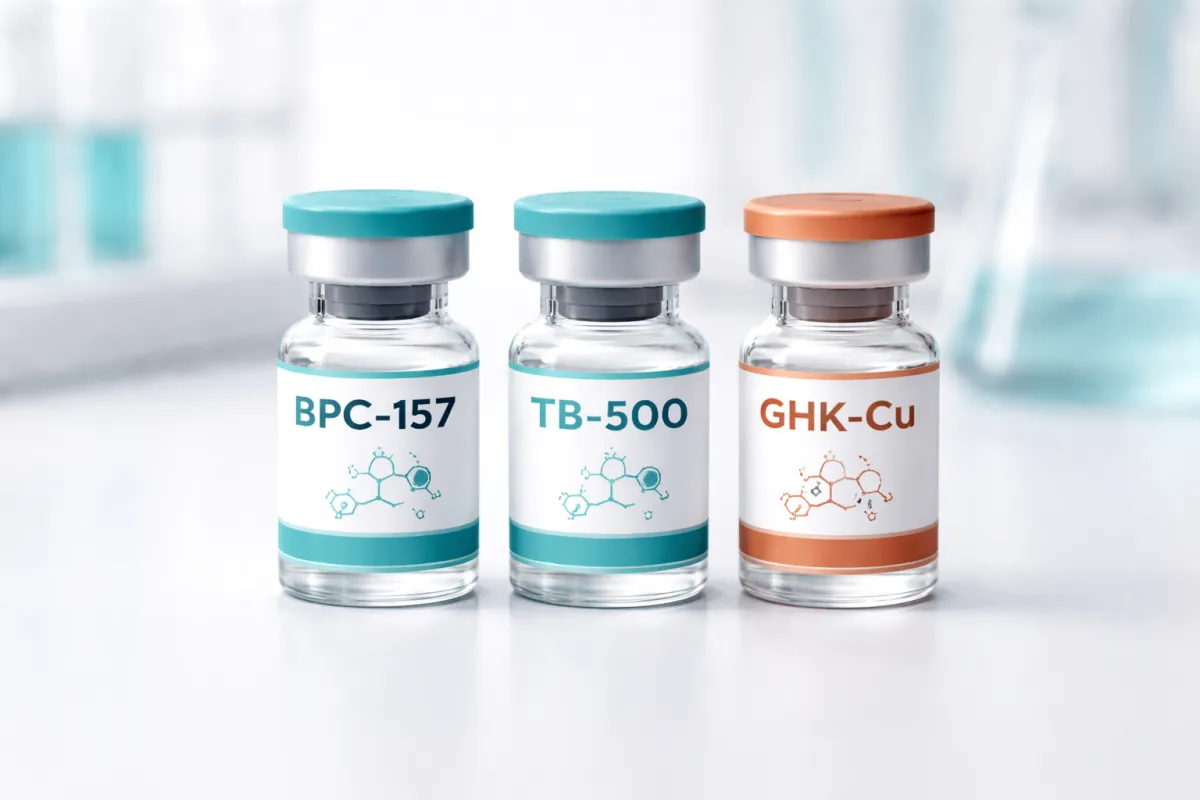
The GLOW Stack: BPC-157 + TB-500 + GHK-Cu Complete Protocol Guide
The Wolverine Stack upgraded with raw materials for superior tissue regeneration.
AI SUMMARY
Definition: The GLOW Stack adds GHK-Cu to the Wolverine Stack (BPC-157 + TB-500), providing collagen-building materials alongside repair signaling.
Primary Use: Severe soft tissue injuries, post-surgical recovery, scar tissue remodeling, and accelerated healing with improved tissue quality.
Typical Timeline: Initial improvements at 2-3 weeks, significant structural healing at 6-8 weeks, collagen remodeling continues through 12 weeks.
Best For: Athletes recovering from surgery, anyone with chronic injuries involving scar tissue, or those wanting enhanced healing quality beyond basic repair.
Not For: Minor injuries where the Wolverine Stack alone would suffice, or those on a tight budget.
Why Add GHK-Cu to the Wolverine Stack
The Wolverine Stack (BPC-157 + TB-500) handles most injuries effectively. BPC-157 builds blood vessels and recruits repair cells. TB-500 coordinates the systemic response and sends stem cells to the damage site.
But here's what's missing: raw materials.
Think of it this way. You've got the construction crew (BPC-157) and the project manager (TB-500) on site. They're ready to work. But the supply trucks haven't arrived. No lumber, no concrete, no building materials. The crew stands around waiting.
GHK-Cu is your supply truck fleet. It delivers collagen, elastin, and glycosaminoglycans directly to the construction site. Now your crew has everything they need to actually rebuild the tissue.
This is why the GLOW Stack produces noticeably better tissue quality than the Wolverine Stack alone. You're not just repairing damage. You're rebuilding with premium materials.
What GHK-Cu Brings to the Stack
GHK-Cu (glycyl-L-histidyl-L-lysine copper) is a naturally occurring tripeptide that declines with age. At 20 years old, you have around 200 ng/mL in your blood. By 60, that drops to 80 ng/mL. This decline correlates directly with reduced healing capacity.
Research shows GHK-Cu influences over 4,000 human genes, shifting expression patterns from destruction toward healthy remodeling. It's not just a collagen booster. It's a gene modulator that resets cellular behavior toward regeneration.
What GHK-Cu does in the stack:
Stimulates collagen synthesis. Clinical trials show 70% of subjects using GHK-Cu had increased collagen production, outperforming both vitamin C and retinoic acid.
Delivers copper to metalloenzymes. Copper is essential for lysyl oxidase and lysyl hydroxylase, the enzymes that cross-link collagen fibers for strength. Without adequate copper, newly synthesized collagen remains weak.
Accelerates wound closure. Studies document 40-50% faster wound healing compared to controls. GHK-Cu enhances all phases: inflammatory modulation, proliferative stimulation, and remodeling optimization.
Reduces scar tissue formation. By balancing matrix metalloproteinase (MMP) activity, GHK-Cu promotes beneficial remodeling while preventing excessive scarring.
Supports nerve regeneration. Research shows increased nerve growth factor and neurotrophins NT-3 and NT-4 production, speeding regeneration of nerve fibers.
The Complete GLOW Stack Synergy
When you combine all three peptides, each handles a distinct phase of healing:
BPC-157 (First Responder):
Builds new blood vessels to the injury (angiogenesis)
Recruits fibroblasts and repair cells
Controls local inflammation
Works primarily at the injection site
TB-500 (Project Manager):
Sends stem cells from bone marrow to damage site
Rebuilds cellular scaffolding (actin cytoskeleton)
Reduces scar tissue formation
Works systemically throughout the body
GHK-Cu (Supply Trucks):
Delivers collagen, elastin, glycosaminoglycans
Provides copper for enzyme function
Modulates gene expression toward regeneration
Ensures rebuilt tissue has structural integrity
The result: faster healing AND better quality tissue. You're not just patching the damage. You're rebuilding it stronger than before.
The Protocol
Standard GLOW Stack Protocol
BPC-157:
Dose: 250-500 mcg daily
Timing: Morning, or split AM/PM
Injection: Subcutaneous, near the injury site
Duration: 8-12 weeks
TB-500:
Loading (weeks 1-4): 2-5 mg twice weekly
Maintenance (weeks 5-12): 2 mg once weekly
Injection: Subcutaneous anywhere (systemic)
Duration: 8-12 weeks
GHK-Cu:
Dose: 1-2 mg daily
Timing: Morning or evening
Injection: Subcutaneous, can be near injury or abdomen
Duration: 8-12 weeks
Run all three simultaneously for full synergistic effect.
Aggressive Protocol (Post-Surgery or Severe Trauma)
BPC-157: 500 mcg twice daily (1 mg total) TB-500: 5 mg twice weekly during loading GHK-Cu: 2 mg daily
This approach is appropriate for ACL reconstruction, rotator cuff repair, or other significant surgical recovery.
Reconstitution
BPC-157 (5mg vial):
Add 2mL BAC water = 2.5 mg/mL
250 mcg = 10 units on insulin syringe
500 mcg = 20 units
TB-500 (10mg vial):
Add 2mL BAC water = 5 mg/mL
2.5 mg = 50 units (0.5mL)
5 mg = 100 units (1mL)
GHK-Cu (50mg vial):
Add 2mL BAC water = 25 mg/mL
1 mg = 4 units
2 mg = 8 units
Note: GHK-Cu can cause stinging at injection site. If this occurs, use more bacteriostatic water to dilute (e.g., 4mL instead of 2mL).
What to Expect
Week 1-2:
Inflammation begins decreasing
Pain at rest reduces
Sleep quality may improve
Week 3-4:
Noticeable improvement in range of motion
Pain during activity decreases
Swelling continues reducing
Skin quality improvements if using GHK-Cu systemically
Week 5-8:
Structural healing progresses significantly
Strength begins returning
Scar tissue softening (if present)
Movement patterns normalizing
Week 9-12:
Collagen remodeling continues
Tissue density and quality improving
Long-term structural integrity developing
The extended 12-week timeline matters because GHK-Cu's collagen remodeling effects take longer to fully manifest than basic tissue repair. Stopping at 6 weeks means missing the quality improvements.
GLOW Stack vs Wolverine Stack: When to Upgrade
Stick with Wolverine Stack (BPC + TB-500) for:
Acute injuries less than 4 weeks old
Minor sprains and strains
General maintenance and recovery
Budget constraints
Upgrade to GLOW Stack for:
Post-surgical recovery
Chronic injuries with scar tissue
Injuries older than 6 weeks
Poor healing history
When tissue quality matters (athletes returning to sport)
Tendon or ligament damage requiring structural rebuilding
The Wolverine Stack handles 80% of injuries effectively. The GLOW Stack is for when you need that extra 20% of healing quality.
Pre-Made GLOW Blends
Several vendors offer pre-made GLOW blends combining all three peptides in one vial. This simplifies reconstitution and reduces the number of injections.
Typical GLOW blend composition:
GHK-Cu: 50mg
BPC-157: 10mg
TB-500: 10mg
One injection delivers all three peptides. Convenient for those who want the full stack without managing multiple vials.
Common Mistakes
Adding GHK-Cu to minor injuries: The GLOW Stack is overkill for a mild ankle sprain. Save it for significant injuries where tissue quality matters.
Skipping the loading phase: TB-500 needs front-loading to reach therapeutic levels. Don't skip weeks 1-4 of twice-weekly dosing.
Stopping too early: GHK-Cu's collagen remodeling takes 8-12 weeks. Stopping at 4-6 weeks means missing the tissue quality improvements that justify adding it to the stack.
Expecting GHK-Cu to work topically for deep injuries: Topical GHK-Cu helps skin. For tendons, ligaments, and deep tissue, injectable is necessary.
The "Copper Uglies": Rare paradoxical reaction where skin appears to age rather than improve. Theory: excessive MMP activation tips toward collagen breakdown. Solution: start with lower GHK-Cu doses (0.5-1mg) and increase gradually.
Safety Considerations
All three peptides have demonstrated good safety profiles in preclinical research.
Potential side effects:
Injection site reactions (redness, minor irritation)
GHK-Cu stinging at injection site (dilute more if needed)
Headache (uncommon)
Fatigue (usually temporary)
Contraindications:
Active cancer or history of cancer (theoretical concern with angiogenesis and growth factor promotion)
Pregnancy or breastfeeding
Children under 18
Drug interactions: No significant interactions documented. Inform your healthcare provider if you're on blood thinners, immunosuppressants, or cancer treatments.
Important: None of these peptides are FDA-approved for human use. All are banned by WADA. This information is for research and educational purposes only.
Supply List for 12 Weeks
Peptides:
BPC-157: 3-4 vials (10mg each) at 500mcg daily
TB-500: 4-5 vials (10mg each) for loading + maintenance
GHK-Cu: 2-3 vials (50mg each) at 1-2mg daily
OR
GLOW Blend: 3-4 vials (pre-made combination)
Supplies:
Bacteriostatic water: 30-40mL total
Insulin syringes: 100+ (29-31 gauge)
Alcohol prep pads
Sharps container
Trusted Sources
Quality matters for injectable peptides. These suppliers provide third-party tested research compounds:
US Suppliers:
Modern Aminos (Code: zach10 for 10% off)
Optimum Formula (Code: BHACK for 10% off)
ResearchChemHQ (Code: BHACK)
Limitless Life Nootropics (Code: BHACK for 15% off)
BioLongevity Labs (Code: BHACK for 15% off)
Canadian Suppliers:
BioSLab (Code: BHACK for 10% off)
European Suppliers:
LimitlessBioChem (Code: BHACK for 10% off)
Most of these vendors carry BPC-157, TB-500, GHK-Cu individually, plus pre-made GLOW and KLOW blends. Always verify third-party testing certificates before purchasing research peptides.
Frequently Asked Questions
Is the GLOW Stack worth the extra cost over the Wolverine Stack? For minor injuries, no. For post-surgical recovery, chronic injuries, or when tissue quality matters for return to sport, yes. The improved collagen density and reduced scarring justify the additional expense.
Can I add GHK-Cu to an existing Wolverine Stack protocol? Yes. If you're already running BPC-157 and TB-500, you can add GHK-Cu at any point. The sooner the better for tissue quality benefits.
What's the difference between GLOW and KLOW blends? KLOW adds KPV, an anti-inflammatory peptide. KLOW is better for injuries with significant inflammation or gut involvement. GLOW is the standard tissue regeneration stack.
Can I use topical GHK-Cu instead of injectable? Topical works for skin-level benefits (wrinkles, skin quality). For tendons, ligaments, and deep tissue healing, injectable is necessary to reach the target tissue.
How long should I wait between GLOW Stack cycles? After a full 12-week cycle, take 4-6 weeks off before starting another. This allows your body to consolidate the healing and prevents receptor desensitization.
The Bottom Line
The GLOW Stack takes the proven Wolverine combination and adds the raw materials needed for superior tissue regeneration. BPC-157 recruits the repair crew. TB-500 coordinates the project. GHK-Cu delivers the building supplies.
For anyone recovering from surgery, dealing with chronic injuries, or wanting the best possible tissue quality after healing, the GLOW Stack represents the next tier of peptide-based tissue repair.
It costs more. It takes longer. But when healing quality matters, this is the stack that delivers.
Related Guides:
Disclaimer: This content is for educational and research purposes only. Peptides are not approved for human use. Nothing here is medical advice. Consult a qualified professional for personalized guidance.
