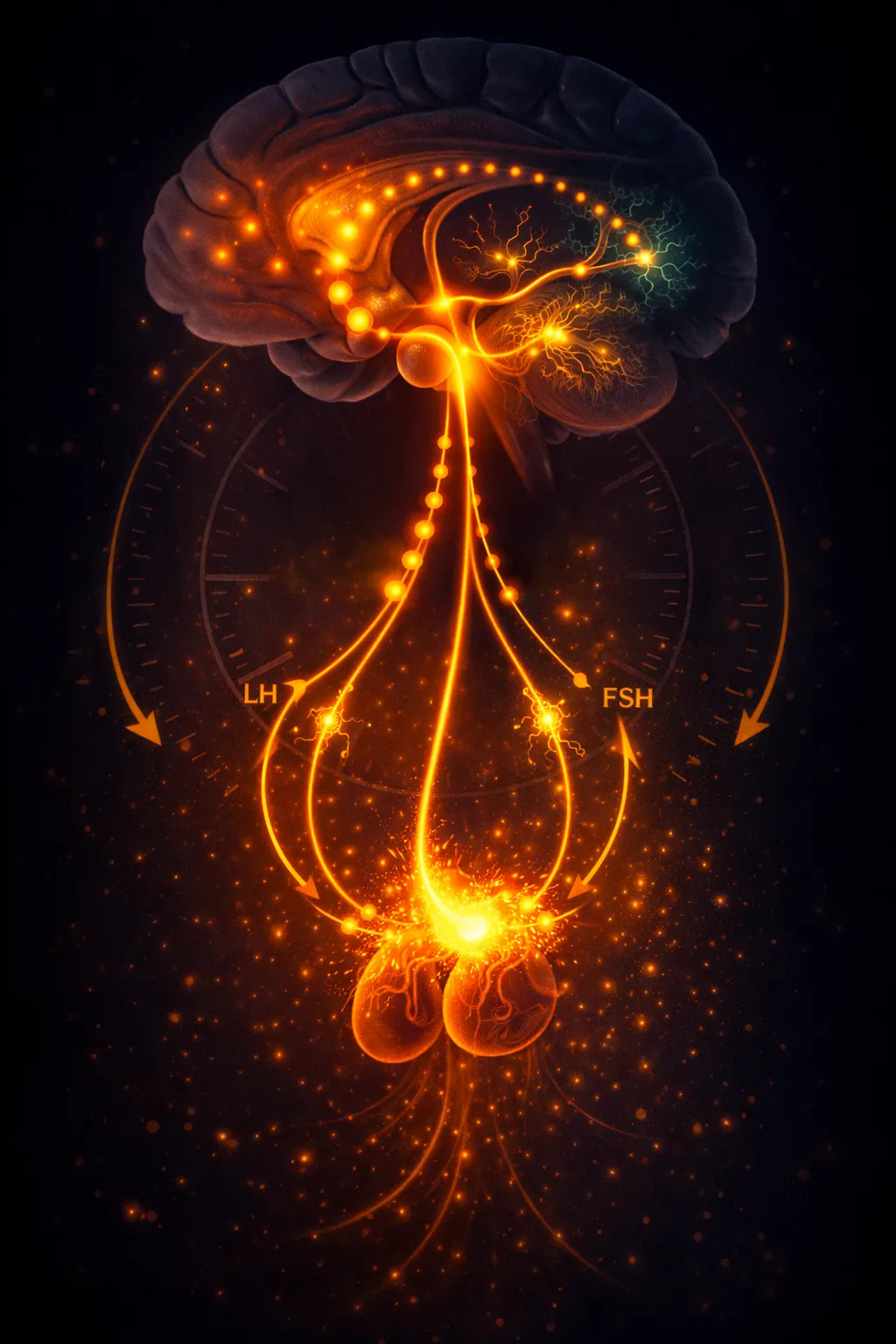
Gonadorelin: The Natural Testosterone Restart Peptide
Most testosterone problems are not factory problems. They are communication problems.
Your testes can produce testosterone. Your pituitary can release LH and FSH. But somewhere along the chain, the signal stopped getting through. Maybe chronic stress suppressed your hypothalamus. Maybe exogenous hormones shut down your natural production. Maybe age gradually degraded the signaling cascade.
Gonadorelin addresses the communication problem directly. This synthetic decapeptide mimics your body's natural gonadotropin-releasing hormone (GnRH), the master signal that tells your pituitary to produce LH and FSH, which in turn tell your testes to produce testosterone and support sperm production.
Unlike testosterone replacement therapy, which supplies the hormone externally and often shuts down natural production entirely, gonadorelin works upstream. It restores the signal. It restarts the system. It lets your body make its own testosterone.
For post-cycle recovery, fertility preservation during hormone therapy, or addressing secondary hypogonadism from hypothalamic dysfunction, gonadorelin offers something testosterone replacement cannot: the possibility of fixing the problem rather than just treating the symptom.
KEY FACTS
Definition: Gonadorelin is a synthetic 10 amino acid peptide identical to natural gonadotropin-releasing hormone (GnRH) that stimulates pituitary release of LH and FSH to restore endogenous testosterone production
Primary Use: Post-cycle therapy after anabolic steroid use, fertility preservation during testosterone therapy, treatment of secondary hypogonadism from hypothalamic dysfunction
Typical Timeline: LH and FSH response within hours; testosterone elevation over 2 to 4 weeks; fertility restoration over 6 to 12 weeks
Best For: Men with functional testes whose testosterone issues stem from upstream signaling problems, those seeking to maintain fertility alongside hormone optimization
Not For: Primary testicular failure (damaged testes), pituitary tumors or damage, those requiring immediate testosterone replacement
What Is Gonadorelin?
Gonadorelin is a synthetic decapeptide with the same amino acid sequence as naturally occurring GnRH. The molecule was isolated and sequenced in 1971 by Andrew Schally, who received the Nobel Prize in Medicine in 1977 for this work along with Roger Guillemin and Rosalyn Yalow.
Naturally, GnRH is released in pulses from specialized neurons in the hypothalamus. These pulses travel through the hypophyseal portal system to the anterior pituitary, where they bind to GnRH receptors on gonadotrope cells. This binding triggers the synthesis and release of two critical hormones: luteinizing hormone (LH) and follicle-stimulating hormone (FSH).
In men, LH acts on Leydig cells in the testes to stimulate testosterone production. FSH acts on Sertoli cells to support spermatogenesis. Together, these hormones drive the reproductive system that exogenous testosterone replacement shuts down.
The critical insight is pulsatility. Natural GnRH release occurs in discrete pulses, typically every 60 to 120 minutes. This pulsatile pattern is essential for maintaining pituitary sensitivity and proper gonadotropin release. Continuous GnRH exposure, paradoxically, causes receptor downregulation and suppresses LH and FSH production rather than stimulating it.
This mechanism explains both gonadorelin's therapeutic potential and the importance of proper dosing protocols.
The Science
The Hypothalamic-Pituitary-Gonadal Axis
Understanding gonadorelin requires understanding the HPG axis. This hormonal cascade begins in the hypothalamus, passes through the pituitary, and terminates at the gonads.
The hypothalamus releases GnRH in pulses. The pituitary receives these pulses and responds by releasing LH and FSH. The testes receive LH and FSH signals and respond by producing testosterone and sperm. Rising testosterone feeds back to the hypothalamus and pituitary, reducing GnRH, LH, and FSH release.
When external testosterone enters this system, it suppresses the feedback signals. The hypothalamus stops releasing GnRH. The pituitary stops releasing LH and FSH. The testes, receiving no stimulation, stop producing testosterone and sperm. They may even shrink from disuse.
Gonadorelin intervenes at the first step of this cascade. By providing the GnRH signal directly, it bypasses hypothalamic suppression and directly stimulates pituitary gonadotropin release.
Pulsatile vs Continuous Administration
Research demonstrates that the pattern of GnRH exposure determines its effect. Pulsatile administration mimics natural physiology and maintains pituitary responsiveness. Continuous administration causes receptor desensitization and paradoxical suppression.
This is why long-acting GnRH agonists are used therapeutically to suppress testosterone in prostate cancer. Continuous exposure shuts down the system. Pulsatile exposure activates it.
For testosterone restoration, the goal is pulsatile or intermittent dosing that stimulates rather than suppresses. Clinical studies using pulsatile gonadorelin pumps demonstrate sustained testosterone elevation and spermatogenesis induction.
Receptor Mechanisms
GnRH receptors on pituitary gonadotropes activate phosphatidylinositol signaling cascades. This pathway involves protein kinase C activation and calcium mobilization, ultimately triggering LH and FSH release.
The frequency and amplitude of GnRH pulses determine the ratio of LH to FSH produced. Different pulse patterns favor different gonadotropin outputs, allowing the system to adjust reproductive function to changing circumstances.
Research Evidence
Hypogonadotropic Hypogonadism Studies
Congenital hypogonadotropic hypogonadism (CHH) provides a natural model for testing gonadorelin's ability to restore HPG axis function. In CHH, the hypothalamus fails to produce GnRH from birth, resulting in absent puberty and infertility.
A study published in the American Journal of Men's Health compared pulsatile gonadorelin pump therapy with cyclical gonadotropin therapy (HCG/HMG injections) in CHH patients. Gonadorelin was administered at 10 mcg every 90 minutes subcutaneously. Results showed that pulsatile gonadorelin induced earlier spermatogenesis than cyclical gonadotropin therapy, with comparable overall success rates.
The study noted that 96% of gonadorelin cycles achieved ovulation in female subjects, with 75% exhibiting mono-follicular ovulation, the natural pattern.
Post-Cycle Recovery Research
Research examining gonadorelin for post-steroid recovery shows it can stimulate LH elevation even in subjects with prior anabolic steroid exposure. One study including subjects with AAS exposure found that gonadorelin significantly raised LH levels in all groups, though the magnitude was reduced compared to controls.
A case study documented restoration of testosterone from severely suppressed levels (130 ng/dL) following anabolic steroid use. Symptoms including testicular shrinkage were controlled after gonadorelin presentation, demonstrating recovery potential even after prolonged suppression.
Fertility Preservation
Research on functional hypothalamic amenorrhea (FHA) in women demonstrates gonadorelin's ability to restore ovulation through pulsatile administration. Using implanted pumps delivering gonadorelin every 90 minutes, researchers achieved 96% ovulation rates with preserved mono-follicular development.
For men on testosterone replacement therapy, gonadorelin offers potential fertility preservation by maintaining LH and FSH stimulation even while exogenous testosterone provides androgenic effects.
Diagnostic Applications
Gonadorelin is established as a diagnostic tool for assessing pituitary function. The GnRH stimulation test measures LH and FSH response to gonadorelin administration, helping distinguish between hypothalamic and pituitary causes of hypogonadism.
A robust LH/FSH response to gonadorelin indicates functional pituitary tissue capable of responding to restored GnRH signaling. A blunted response suggests pituitary damage requiring different intervention.
Practical Protocols
Administration
Gonadorelin is typically administered subcutaneously. The peptide has a very short half-life (minutes), which is why pulsatile delivery most closely mimics natural physiology.
Clinical pulsatile protocols use infusion pumps delivering 5 to 20 mcg every 90 to 120 minutes. This approach is impractical for most non-clinical settings.
Practical protocols adapt to this limitation by using intermittent dosing to approximate pulsatility. Multiple daily injections spaced throughout the day provide intermittent stimulation that maintains pituitary responsiveness.
Research Protocol Dosing
Most non-clinical protocols use 100 to 200 mcg per injection, administered 2 to 3 times daily. This provides intermittent rather than continuous stimulation.
Timing: Morning, afternoon, and evening dosing spreads stimulation throughout the day. Some protocols use morning and evening only.
Duration: 4 to 8 weeks is typical for most applications. Post-cycle recovery may require the longer end. Fertility support during TRT may continue longer under medical supervision.
Avoiding Desensitization
The critical consideration is avoiding continuous exposure that causes receptor downregulation. Spacing doses throughout the day with significant gaps between injections maintains pulsatile-like stimulation.
Do not exceed 8 weeks continuous use without breaks. If longer protocols are needed, cycle 8 weeks on, 4 weeks off.
Monitor response. If LH and testosterone are not rising after 4 weeks, the problem may not be addressable by gonadorelin (primary testicular failure, pituitary damage, etc.).
Bloodwork Requirements
Baseline bloodwork before starting: LH, FSH, testosterone, estradiol.
If baseline LH and FSH are already elevated with low testosterone, this indicates primary testicular failure. Gonadorelin will not help because the testes themselves are not responding to existing gonadotropin signals.
If baseline LH and FSH are low with low testosterone, this indicates secondary hypogonadism. Gonadorelin may restore function by providing the missing upstream signal.
PROTOCOL SUMMARY (TEXT): Gonadorelin is administered subcutaneously at 100 to 200 mcg per injection, 2 to 3 times daily, spaced throughout the day to provide intermittent rather than continuous stimulation. Cycles of 4 to 8 weeks with breaks prevent receptor desensitization. Bloodwork confirms appropriate candidate selection (low LH/FSH with low testosterone indicates potential responder).
What to Expect
Week 1 to 2
LH and FSH levels begin rising within hours of administration. Initial testosterone response follows over days. Some users report increased morning erections and testicular fullness as Leydig cells reactivate. Energy may begin improving.
Week 3 to 4
Testosterone levels measurably elevated on bloodwork. Libido improvement becomes noticeable. Mood and cognitive function stabilize. Post-cycle users see clear signs of HPTA recovery.
Week 6 to 8
Peak testosterone response for most users, though individual variation is substantial. Fertility markers improve (sperm count, motility) in those tracking these parameters. Full recovery of testicular function in post-cycle scenarios with moderate prior suppression.
Individual Variation
Response depends heavily on degree of prior HPG axis suppression, duration of suppression, and underlying testicular and pituitary health.
Men with mild hypogonadism or recovering from short steroid cycles may see rapid results. Those with severe long-term suppression may require longer protocols and may not fully recover without additional interventions.
If no response after 4 weeks, reevaluate. The problem may be pituitary damage, testicular damage, or other issues gonadorelin cannot address.
Advanced Stacking
Gonadorelin + hCG (Post-Cycle Recovery)
Combine gonadorelin for upstream pituitary stimulation with hCG for direct testicular stimulation. Hit both levels of the cascade simultaneously for faster recovery.
Gonadorelin 100 to 200 mcg twice daily plus hCG 250 to 500 IU every other day. Duration 4 to 6 weeks. Transition off hCG first while maintaining gonadorelin, then taper gonadorelin as natural LH production stabilizes.
Gonadorelin + Kisspeptin (Upstream Stack)
Kisspeptin stimulates natural GnRH release from the hypothalamus. Gonadorelin directly activates pituitary GnRH receptors. Together they address the full upstream cascade.
Kisspeptin 1 to 2 mcg daily plus Gonadorelin 100 mcg twice daily. Duration 4 to 8 weeks. This represents the most physiological restart protocol, working at every level above the testes.
Gonadorelin + Enclomiphene (SERM Bridge)
Use gonadorelin for initial restart, then transition to enclomiphene to maintain elevated gonadotropins while tapering peptides.
Weeks 1 to 4: Gonadorelin 200 mcg twice daily. Weeks 5 to 8: Enclomiphene 12.5 to 25 mg daily. The SERM blocks estrogen feedback, keeping LH/FSH elevated as natural production takes over.
Gonadorelin + BPC-157 + TB-500 (Full Recovery Stack)
For post-cycle recovery with joint or tissue damage from heavy training.
Gonadorelin 200 mcg twice daily plus BPC-157 250 to 500 mcg daily plus TB-500 2 mg twice weekly. Duration 6 to 8 weeks. Comprehensive recovery at hormonal, tissue, and systemic levels.
Safety and Side Effects
Generally Well-Tolerated
Gonadorelin has been used clinically for decades with an established safety profile. Side effects at appropriate doses are typically mild.
Common Effects
Injection site irritation (subcutaneous administration)
Transient headache (uncommon, usually first few doses)
Mild nausea (rare)
The Flare Effect
Continuous or excessively high-dose gonadorelin can cause an initial testosterone surge followed by receptor downregulation and paradoxical suppression. This is the mechanism used therapeutically to suppress testosterone in prostate cancer.
Avoid this by using appropriate intermittent dosing, cycling protocols, and not exceeding 8 weeks continuous use without breaks.
Contraindications
Primary testicular failure (damaged testes) will not respond because the testes cannot produce testosterone regardless of stimulation.
Pituitary tumors or damage require medical evaluation. Gonadorelin stimulation could theoretically affect pituitary tumor behavior.
Those requiring immediate testosterone replacement for severe symptoms should not wait for gonadorelin protocols to work.
Monitoring
Regular bloodwork (LH, FSH, testosterone) every 4 weeks during use. If LH/FSH rise but testosterone does not, this indicates testicular dysfunction requiring different intervention.
Comparing Gonadorelin to Alternatives
Gonadorelin vs hCG
hCG acts directly on testicular LH receptors, bypassing the pituitary entirely. Gonadorelin acts on the pituitary to stimulate natural LH release.
hCG provides faster, more direct testicular stimulation but does not restore the full HPG axis. Gonadorelin addresses the upstream signaling cascade for more physiological recovery.
For post-cycle therapy, many protocols combine both for complementary effects at different levels of the axis.
Gonadorelin vs Clomiphene/Enclomiphene
SERMs block estrogen feedback at the hypothalamus and pituitary, indirectly increasing LH and FSH. They work through negative feedback modulation rather than direct stimulation.
Gonadorelin directly provides the GnRH signal. It is more targeted but requires injection. SERMs are oral but have broader effects on estrogen signaling throughout the body.
Combining gonadorelin with SERMs can provide both direct stimulation and feedback modulation.
Gonadorelin vs Testosterone Replacement
TRT supplies testosterone exogenously, shutting down natural production and often causing testicular atrophy and infertility.
Gonadorelin restores natural production, preserves fertility, and maintains testicular function.
TRT is appropriate when the HPG axis is irreparably damaged or when immediate symptom relief is required. Gonadorelin is appropriate when natural production can potentially be restored.
Frequently Asked Questions
Can gonadorelin replace testosterone therapy?
For some individuals with secondary hypogonadism from hypothalamic dysfunction, yes. For those with primary testicular failure or permanent HPG axis damage, no. Bloodwork helps determine which category applies.
Will gonadorelin preserve fertility on TRT?
Potentially. By maintaining LH and FSH stimulation, gonadorelin may help preserve testicular function and spermatogenesis even while exogenous testosterone provides androgenic effects. This requires careful medical supervision.
How does gonadorelin compare to HCG for PCT?
They work at different levels. hCG directly stimulates the testes; gonadorelin stimulates the pituitary to release the signals that stimulate the testes. Many PCT protocols use both for comprehensive axis recovery.
Why is pulsatile dosing important?
Continuous GnRH exposure causes pituitary receptor desensitization and paradoxical suppression. Pulsatile or intermittent exposure maintains receptor sensitivity and achieves stimulation rather than suppression.
How long until I see results?
LH and FSH typically respond within days. Testosterone elevation becomes measurable within 2 to 4 weeks. Full recovery, especially for fertility markers, may take 6 to 12 weeks or longer depending on degree of prior suppression.
Trusted Sources
Quality matters with research peptides. Third-party testing and proper handling make the difference between effective research and wasted effort.
Vetted supplier carrying Gonadorelin:
BioSLab Canada Gonadorelin 5mg | Code: BHACK (10% off)
For stacking options:
BioSLab Canada Kisspeptin-10 | Code: BHACK (10% off)
Modern Aminos Enclomiphene | Code: zach10 (10% off)
For complete vendor comparison and additional options: biohackblueprint.io
The Bigger Picture
Gonadorelin represents a fundamentally different approach to testosterone optimization than replacement therapy. Instead of supplying the missing hormone, it restores the signaling cascade that produces it.
This matters for several reasons. Natural testosterone production follows pulsatile patterns that replacement therapy cannot replicate. Fertility requires LH and FSH signaling that exogenous testosterone suppresses. Testicular function depends on ongoing stimulation that hormone replacement eliminates.
The limitation is that gonadorelin only works when the downstream components function properly. If your testes are damaged, no amount of pituitary stimulation will restore testosterone production. If your pituitary is damaged, gonadorelin cannot act on missing tissue.
This is why bloodwork matters. If your LH and FSH are already high but testosterone is low, the testes are failing to respond to existing signals. Gonadorelin will not help. If your LH and FSH are low with low testosterone, the problem is upstream signaling. Gonadorelin may restore it.
For post-cycle recovery, the logic is straightforward. Exogenous steroids suppress the HPG axis by providing the hormones that would normally signal the axis to slow down. Removing the exogenous hormones does not immediately restore the suppressed signals. Gonadorelin provides those signals directly, accelerating recovery.
The takeaway: fix the communication problem before replacing the hormone. Restart the system before declaring it broken. And always verify through bloodwork that gonadorelin addresses the actual cause of dysfunction.
Final Thoughts
Gonadorelin offers something testosterone replacement cannot: the possibility of restoring your body's own production rather than substituting external hormones indefinitely.
This is not always the right approach. Some conditions require direct hormone replacement. Some damage is irreparable. Some situations demand immediate relief that natural restoration cannot provide quickly enough.
But for those whose testosterone problems stem from signaling dysfunction rather than organ failure, gonadorelin represents a more physiological solution. It works with your body's systems rather than bypassing them. It preserves fertility rather than sacrificing it. It maintains testicular function rather than allowing atrophy.
The key is proper candidate selection. Bloodwork identifies who can benefit. Appropriate protocols avoid the desensitization that would undermine the approach. Monitoring confirms response and guides adjustments.
For post-cycle recovery, fertility preservation, or secondary hypogonadism from hypothalamic dysfunction, gonadorelin addresses the root cause. It fixes the phone line rather than hiring someone to do the work your factory can handle itself.
What has your experience been with gonadorelin for testosterone restoration or post-cycle recovery? How did it compare to other approaches? Share your protocols in the comments.
Disclaimer: This content is for educational and research purposes only. Peptides are not approved for human use. Nothing here is medical advice. Consult a qualified professional for personalized guidance.
