P21: The Complete Guide to the Neurogenesis Amplifier
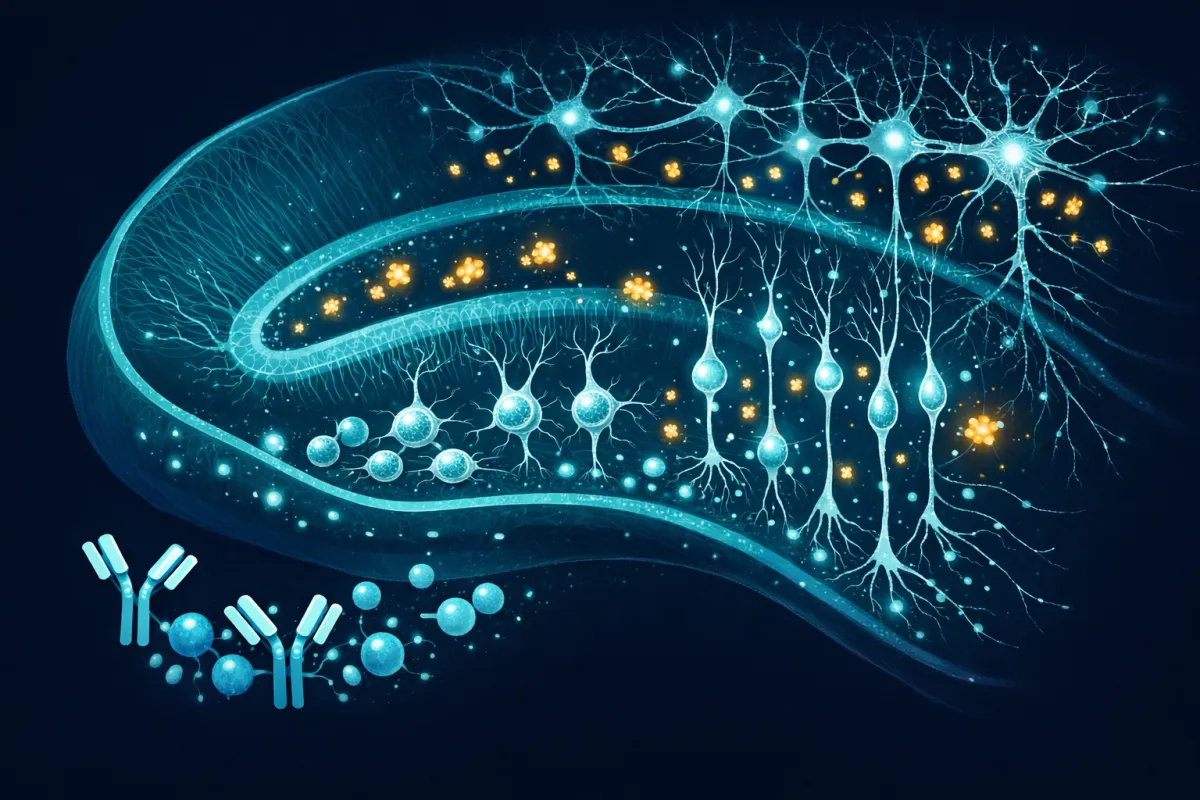
Your brain is constantly trying to repair itself. In the hippocampus, the region responsible for memory and learning, neural stem cells divide and differentiate into new neurons throughout your entire life. This process, neurogenesis, is one of the brain's most remarkable capabilities.
But here is the problem: your body also produces antibodies that neutralize CNTF, the growth factor that drives this process. As you age, these neutralizing antibodies increase while CNTF activity decreases. The brain's repair system gets progressively blocked. Neurogenesis slows. Cognitive function declines.
P21 removes the roadblock.
Instead of introducing foreign growth factors that trigger immune responses, P21 neutralizes the antibodies that block your existing CNTF. Your brain's natural neurogenic machinery is freed to work at full capacity. New neurons form. Synapses strengthen. Memory improves.
This is not stimulation. This is restoration.
KEY FACTS
Definition: P21 is a synthetic CNTF mimetic peptide (Ac-DGGLAG-NH2) that amplifies endogenous neurotropic signaling by neutralizing CNTF-blocking antibodies
Primary Use: Cognitive enhancement, neuroprotection, Alzheimer's prevention, age-related cognitive decline
Mechanism: Inhibits LIF signaling, increases BDNF expression, reduces tau hyperphosphorylation via the BDNF/TrkB/PI3-K/AKT/GSK3β pathway
Typical Timeline: 30 days minimum for neurogenic effects, 90 days for full benefit
Best For: Age-related cognitive decline, Alzheimer's prevention, traumatic brain injury recovery, long-term cognitive optimization
Not For: Those seeking immediate cognitive effects, acute focus enhancement
What Is P21?
P21 (also called P021 or Peptide 6c-adamantylated) is a synthetic hexapeptide with the sequence Ac-DGGLAG-NH2. It was developed through reverse engineering of Cerebrolysin, a complex peptide preparation derived from porcine brain tissue that has been used clinically for decades in stroke, traumatic brain injury, and dementia treatment.
Researchers sought to identify which specific molecular components of Cerebrolysin were responsible for its cognitive benefits. Through epitope mapping studies, they discovered that the effects primarily derived from peptide fragments mimicking CNTF (ciliary neurotrophic factor) activity.
The critical breakthrough came when scientists identified the DGGL tetrapeptide sequence from CNTF residues 147-150 as the minimal active unit retaining neurotrophic activity. They then added adamantane building blocks to enhance blood-brain barrier penetration and metabolic stability.
The result was P21: a small, stable peptide that crosses into the brain efficiently, has a plasma half-life exceeding 6 hours, and produces CNTF-like effects without CNTF's problems.
Why CNTF Itself Cannot Be Used
CNTF is one of the most important neurotrophic factors in the brain. It drives neurogenesis, protects neurons, and regulates synaptic plasticity. But natural CNTF has fatal flaws as a therapeutic:
Too large (22.7 kDa) to cross the blood-brain barrier effectively
Very short plasma half-life requiring constant infusion
Provokes antibody formation when given systemically
Causes severe side effects including anorexia, weight loss, and pain
Recombinant CNTF (Axokine) was developed for ALS treatment but failed clinical trials due to rapid antibody development and intolerable side effects.
P21's Elegant Solution
P21 does not try to replace CNTF or bind to CNTF receptors directly. Instead, it neutralizes the antibodies and molecules that block endogenous CNTF. By removing the inhibition, P21 allows your brain's natural CNTF to work at full effectiveness.
This approach avoids the problems of exogenous CNTF while capturing its benefits. Your body is not fighting a foreign protein. It is simply being allowed to use what it already produces.
The Science: How P21 Restores Neurogenic Capacity
P21's mechanism involves multiple interconnected pathways that collectively enhance the brain's natural repair and growth systems.
Step 1: Antibody Neutralization
CNTF activity in the brain is naturally limited by neutralizing antibodies that bind to CNTF and prevent it from activating receptors. P21 sequesters these antibodies and facilitates their elimination.
Result: Effective CNTF levels increase because less is being blocked.
Step 2: CNTF Receptor Complex Activation
With antibodies neutralized, CNTF can properly activate its receptor complex:
CNTF binds to CNTFRα (CNTF receptor alpha)
This recruits LIFR (LIF β receptor) and gp130 (glycoprotein 130)
The tripartite complex activates JAK/STAT signaling
Step 3: Downstream Signaling Cascades
P21's effects flow through the BDNF/TrkB/PI3-K/AKT/GSK3β pathway:
BDNF Upregulation:
Increases brain-derived neurotrophic factor expression
Activates TrkB receptors
Triggers PI3K/AKT signaling cascade
Activates CREB (transcription factor essential for memory)
GSK3β Inhibition:
AKT phosphorylates and inhibits GSK3β
GSK3β is the major tau kinase (hyperphosphorylates tau in Alzheimer's)
Reduced GSK3β activity means reduced tau pathology
LIF Pathway Suppression:
P21 inhibits leukemia inhibitory factor (LIF) signaling
LIF competes with CNTF for receptor binding
Less LIF means more effective CNTF signaling
The Brain-Level Effects
Neurogenesis:
Increases neural progenitor cell proliferation in the dentate gyrus
Promotes differentiation of stem cells into functional neurons
Enhances survival of newly formed neurons
Maintains the neurogenic niche environment
Synaptic Plasticity:
Increases dendritic spine density
Enhances long-term potentiation (the basis of memory)
Improves synaptic protein levels (PSD-95, synapsin-1)
Promotes neurite outgrowth
Neuroprotection:
Reduces tau hyperphosphorylation
Decreases beta-amyloid production (not clearance)
Protects neurons from oxidative stress
Prevents neuronal apoptosis
Dopaminergic Regulation:
CNTF regulates dopamine D2-receptor-dependent neurogenesis
Normalizes dopaminergic signaling in Parkinson's models
Enhances subventricular zone neurogenesis
Research Evidence: What the Studies Show
P21 has an extensive preclinical research base spanning over a decade, primarily from Dr. Khalid Iqbal's group at the New York State Institute for Basic Research in Developmental Disabilities.
The Alzheimer's Disease Studies
In the landmark 3xTg-AD mouse studies, P21 was added to the diet of mice approximately 6-9 months before the onset of amyloid beta or tau pathology. Results were remarkable:
Rescued deficits in dendritic and synaptic function
Promoted neurogenesis in the hippocampus
Reversed cognitive impairment
Reduced tau hyperphosphorylation at known AD neurofibrillary sites
Decreased soluble amyloid beta levels
No weight loss, tumors, or signs of adverse effects
The 12-month treatment study showed P21 produced robust tau reduction and cognitive rescue without adverse effects, supporting its potential as a disease-modifying treatment for Alzheimer's.
The Cognitive Aging Studies
In aged Fisher rats, P21 demonstrated the ability to counteract age-related cognitive decline. The peptide:
Inhibited deficits in neurogenesis
Upregulated BDNF expression
Improved learning and memory performance
Enhanced spatial reference memory
Oral administration was effective, making P21 practical for long-term use.
The Traumatic Brain Injury Research
In mild-to-moderate TBI models, P21 (50 nmol/animal/day for 30 days) produced significant benefits:
Enhanced hippocampal neurogenesis
Promoted neuronal plasticity
Improved cognitive recovery
Demonstrated blood-brain barrier permeability
Showed plasma half-life exceeding 6 hours
The effects were long-lasting, persisting beyond the treatment period.
P21 vs. Cerebrolysin
Direct comparisons show P21 is more efficacious than Cerebrolysin, likely because:
Cerebrolysin contains CNTF which provokes antibody formation
P21 neutralizes antibodies without introducing foreign CNTF
P21 has superior pharmacokinetics and BBB penetration
Cerebrolysin loses efficacy over time while P21 maintains it
The 2025 Cognitive Peptides Ranking
A 2025 review ranked P21 among the top 7 cognitive research peptides, noting it works through the BDNF/TrkB/PI3-K/AKT/GSK3β pathway to boost hippocampal neurogenesis and enhance memory processes. The review highlighted P21's exceptional stability: over 95% stability in artificial gastric juice for 30 minutes and nearly 100% stability in intestinal conditions.
Practical Protocols: How to Use P21
P21 can be administered via subcutaneous injection or intranasal spray. Oral administration has also shown efficacy in animal studies.
Protocol 1: Standard Cognitive Enhancement
SubQ Administration:
Dose: 500mcg to 1mg daily
Timing: Morning preferred
Duration: Minimum 30 days, optimal 90 days
Cycling: Can be used continuously or cycled 90 days on, 30 days off
Intranasal Administration:
Dose: 1-2mg daily (split AM/PM if using twice daily)
Timing: Morning dose for daytime cognition, evening for memory consolidation
Duration: Same as SubQ
Protocol 2: Neuroprotection/Prevention
For those with Alzheimer's genetic risk or seeking long-term brain health:
Dose: 500mcg daily SubQ or 1mg intranasal
Duration: Continuous use
Monitoring: Baseline cognitive assessment, periodic re-evaluation
Protocol 3: Post-TBI Recovery
Based on preclinical research:
Dose: 1mg daily (higher end of range)
Duration: 30+ days minimum
Start: As soon as possible post-injury
Combination: May stack with other neuroprotective agents
Administration Notes
Reconstitute lyophilized powder with bacteriostatic water
Store reconstituted peptide refrigerated
SubQ injection sites: Abdomen, thigh
Intranasal: Use atomizer spray device for even distribution
Consistent daily timing helps maintain steady state
Why Minimum 30 Days?
Neurogenesis is a slow process. New neural progenitor cells must:
Proliferate (divide)
Differentiate (become neurons)
Migrate to proper locations
Integrate into existing circuits
Form functional synapses
This process takes weeks. Expecting immediate effects from a neurogenic compound misunderstands its mechanism. P21 builds new brain tissue. That takes time.
What to Expect: Realistic Timeline
P21 is not a stimulant. It does not produce immediate cognitive enhancement. It builds new neural infrastructure.
Week 1-2: Minimal Noticeable Effects
Cellular changes are beginning but are not yet functionally apparent. Neural progenitor cells are starting to proliferate. Most users notice nothing dramatic.
Do not discontinue because nothing is happening yet. The process has begun.
Week 3-4: Subtle Shifts
Some users begin noticing:
Slightly improved memory for recent events
Better sleep quality
Subtle mood improvement
Marginally sharper thinking
These are early signs of enhanced neuroplasticity.
Week 5-8: Building Benefits
Neurogenesis is producing measurable effects:
Clearer recall of learned information
Improved ability to learn new material
Better verbal fluency
Enhanced spatial awareness
More consistent cognitive performance
Week 9-12 (90 days): Full Effect
The new neurons have matured and integrated:
Robust memory improvement
Enhanced learning capacity
Improved pattern recognition
Greater cognitive resilience
Benefits that persist even after discontinuation
Long-Term Use
Animal studies up to 12 months showed continued benefit without adverse effects. P21 appears safe for extended use, and the neurogenic benefits may compound over time.
What P21 Will NOT Do
Provide immediate focus or alertness (use Semax or stimulants)
Work in days (requires weeks minimum)
Compensate for poor sleep, nutrition, or chronic stress
Produce dramatic acute effects
P21 is for those willing to invest time in genuine brain building.
Advanced Stacking Strategies
P21 combines well with other cognitive compounds, particularly those working through complementary mechanisms.
Stack 1: The Complete Neurogenesis Stack
P21 + Dihexa + Lion's Mane
Three neurogenic compounds working through different pathways:
P21: CNTF amplification, LIF inhibition
Dihexa: HGF/c-Met activation
Lion's Mane: NGF stimulation
Protocol:
P21: 1mg daily (intranasal or SubQ)
Dihexa: 10-20mg daily (oral)
Lion's Mane: 500-1000mg daily
Duration: 90 days minimum. This is aggressive neurogenic stimulation.
Stack 2: The BDNF Maximizer
P21 + Semax + Exercise
P21 increases BDNF expression. Semax also increases BDNF through different mechanisms. Exercise is the most proven BDNF enhancer.
Protocol:
P21: 500mcg-1mg daily
Semax: 200-400mcg intranasal daily
Exercise: 30+ minutes moderate intensity, 4-5x weekly
This stack maximizes endogenous neurotrophic support.
Stack 3: The Alzheimer's Prevention Stack
P21 + Lithium (microdose) + Omega-3s
For those with genetic risk or early cognitive concerns:
P21: Reduces tau, promotes neurogenesis
Lithium (microdose): GSK3β inhibitor, neuroprotective
Omega-3s: Anti-inflammatory, membrane support
Protocol:
P21: 500mcg daily
Lithium orotate: 5-10mg daily
Omega-3s: 2-3g EPA/DHA daily
Long-term preventive approach.
Stack 4: The Memory Enhancement Stack
P21 + Selank + Alpha-GPC
Focused on memory specifically:
P21: Builds new neurons and synapses
Selank: Reduces anxiety (which impairs memory), BDNF support
Alpha-GPC: Acetylcholine substrate for the new synapses
Protocol:
P21: 1mg daily
Selank: 200-400mcg intranasal daily
Alpha-GPC: 300-600mg daily
Stack 5: The Recovery Stack
P21 + NAD+ + Cerebrolysin
For post-injury or neurodegenerative support:
P21: Neurogenesis and tau reduction
NAD+: Cellular energy and repair
Cerebrolysin: Broad neurotrophic support (despite P21 being superior, they can complement)
Protocol:
P21: 1mg daily
NAD+: 100-250mg SubQ 2x weekly
Cerebrolysin: 5ml IM daily (5-day cycles)
Safety, Side Effects, and Contraindications
P21 has demonstrated excellent safety in preclinical studies, including 12-month treatment protocols with no observed adverse effects.
Reported Side Effects
In animal studies: None reported at therapeutic doses.
Anecdotal human reports:
Occasional mild headache
Vivid dreams
Slight appetite changes (CNTF pathway can affect satiety)
The lack of significant side effects distinguishes P21 from full-length CNTF, which causes anorexia, weight loss, and pain.
Why P21 Is Safer Than CNTF
P21 avoids CNTF's problems because:
It does not introduce foreign protein
It does not trigger antibody formation
It amplifies endogenous signaling rather than overwhelming receptors
The adamantane modification enhances stability without adding toxicity
Theoretical Concerns
Growth factor stimulation: Any compound promoting cellular growth raises theoretical cancer concerns. However, P21's mechanism (amplifying endogenous signaling rather than introducing exogenous growth factors) may mitigate this risk. No tumors were observed in long-term animal studies.
Seizure threshold: Enhanced neurogenesis and plasticity could theoretically affect seizure threshold in susceptible individuals. Those with epilepsy should exercise caution.
Contraindications
Relative:
Active malignancy (theoretical growth factor concerns)
Epilepsy or seizure history
Pregnancy and lactation (no reproductive data)
Autoimmune conditions (theoretical immune modulation)
These reflect precautionary principles given lack of human data rather than documented safety signals.
Long-Term Safety
The 12-month animal studies provide reassurance, but human long-term data does not exist. P21 is still a research compound without clinical trials establishing safety profiles in humans.
Frequently Asked Questions
How does P21 compare to Cerebrolysin?
P21 was derived from Cerebrolysin's most active component but engineered to be superior. P21 has better blood-brain barrier penetration, longer half-life, no antigenicity, and maintains efficacy over time while Cerebrolysin loses effectiveness as antibodies develop.
Can P21 reverse existing cognitive decline?
Animal studies show P21 can rescue cognitive deficits in aged animals and Alzheimer's models. Whether this translates to humans with existing decline is unknown, but the mechanism supports potential benefit.
Is P21 better than Dihexa for neurogenesis?
They work through different mechanisms (CNTF vs HGF/c-Met pathways). Dihexa may be more potent acutely, but P21 may be safer for long-term use due to its mechanism of amplifying endogenous signaling rather than activating growth factor receptors directly. Some researchers combine them.
How long do benefits last after stopping?
The structural changes (new neurons, synapses) should persist after discontinuation since you have literally built new brain tissue. However, the enhanced neurogenic environment requires continued P21 for maintenance.
Can I take P21 orally?
Animal studies used oral administration successfully. P21 shows over 95% stability in gastric conditions. However, SubQ or intranasal administration ensures more predictable bioavailability.
Is P21 the same as the p21 protein in cancer research?
No. The p21 protein (p21^Cip1/Waf1) is a cyclin-dependent kinase inhibitor involved in cell cycle regulation and cancer. The P21 peptide discussed here is a CNTF mimetic for neurogenesis. Same name, completely different molecules.
Trusted Sources
Quality matters with research peptides. Third-party testing ensures purity and potency.
Vetted suppliers carrying P21 with COAs:
Modern Aminos (10mg) - Code: zach10 (10% off)
LimitlessBioChem EU (5mg) - Code: BHACK (10% off)
BioSLab Canada (5mg) - Code: BHACK (10% off)
Limitless Life Nootropics (Nasal Spray) - Code: BHACK (15% off)
For complete vendor comparison and additional resources: biohackblueprint.io
The Bigger Picture
P21 represents a fundamentally different approach to cognitive enhancement. Instead of stimulating receptors or modulating neurotransmitters, it removes the brakes on your brain's natural repair system.
The Neurogenesis Paradigm
Most cognitive enhancers work with what you have. P21 gives you more to work with. By promoting genuine neurogenesis, new functional neurons that integrate into existing circuits, P21 expands cognitive capacity rather than just optimizing existing resources.
This is why immediate effects are minimal but long-term benefits are substantial. You are building new brain tissue. That takes time but produces durable results.
Who Benefits Most
P21 provides greatest value for:
Those concerned about age-related cognitive decline
Individuals with Alzheimer's genetic risk seeking prevention
Anyone recovering from traumatic brain injury
Long-term cognitive optimization goals
Those willing to commit to 90+ day protocols
Who Should Look Elsewhere
P21 is not ideal for:
Those seeking immediate cognitive enhancement (try Semax)
Acute focus or productivity needs (try stimulants)
Anyone unwilling to commit to extended protocols
Those wanting quick, reversible effects
The Honest Assessment
P21 has some of the most compelling preclinical data in the cognitive enhancement space. The mechanism makes biological sense. The 12-month safety data is reassuring. The comparison to Cerebrolysin (a clinically used product) provides context.
However, we have zero human clinical trial data. Everything is extrapolated from animal models. The translation to humans is assumed based on conserved mechanisms, not proven through controlled trials.
For those comfortable with this uncertainty, P21 offers a unique approach to brain health that addresses root causes rather than symptoms.
Final Thoughts
P21 does not make your existing brain work harder. It builds you a better brain.
By neutralizing the antibodies that block CNTF, P21 unleashes your brain's natural capacity for neurogenesis and repair. New neurons form in the hippocampus. Synapses strengthen. Memory improves. Cognitive resilience increases.
This is not overnight optimization. This is long-term investment in neural architecture. The commitment is weeks to months. The payoff is genuine, durable cognitive enhancement and protection against age-related decline.
Your brain wants to repair itself. P21 lets it.
Disclaimer: This content is for educational and research purposes only. P21 is not FDA-approved for any human therapeutic use. Nothing here is medical advice. All information is based on preclinical research without human clinical trial validation. Consult a qualified professional before using any research compound.
