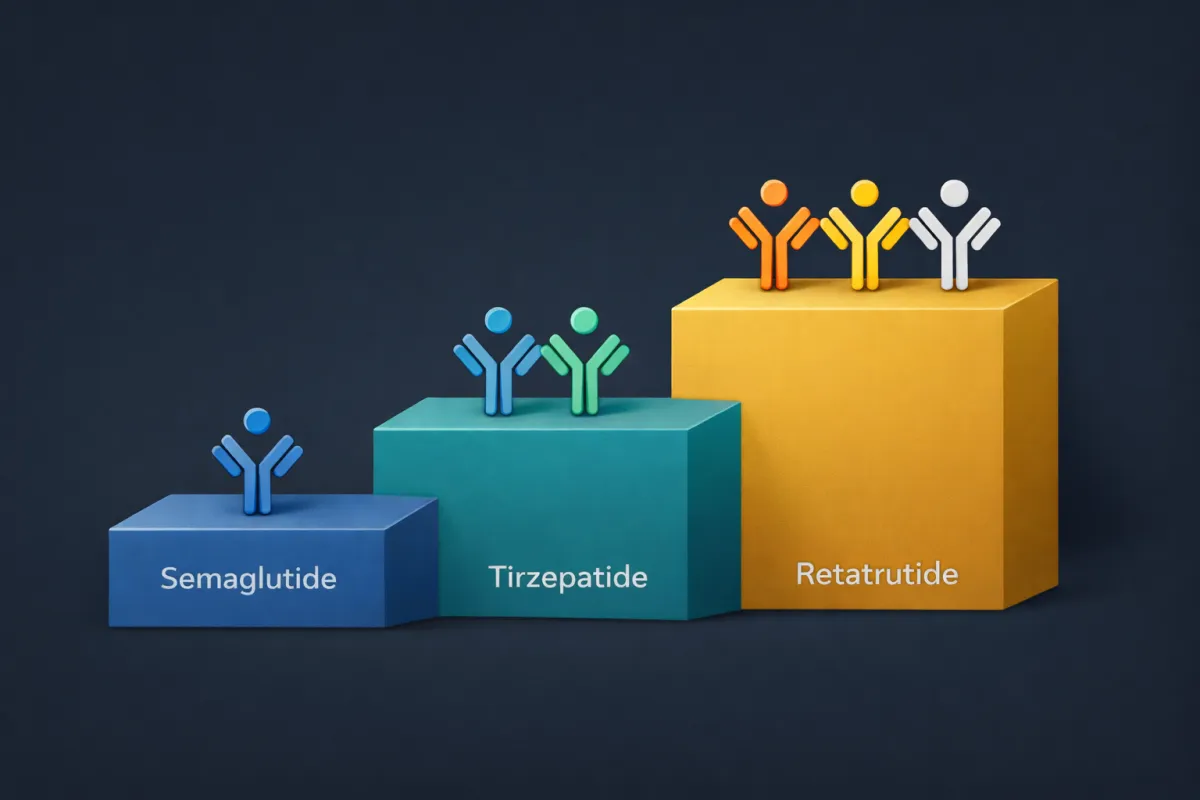
Semaglutide vs. Tirzepatide vs. Retatrutide: The Real Differences Explained
If you are researching weight loss medications, you have probably seen these three names everywhere: Semaglutide, Tirzepatide, and Retatrutide. The internet is full of confusing information. Some articles make them sound identical. Others hype one while ignoring the others.
Here is the truth: these are not the same drug in different packaging. They work through fundamentally different mechanisms, produce different results, and have different limitations. Understanding these differences matters because choosing the wrong one could mean disappointing results, unnecessary side effects, or missing out on benefits you actually need.
This guide breaks down exactly how each one works, what the clinical trials actually show, and why one of them stands clearly above the rest.
KEY FACTS
Semaglutide (Ozempic/Wegovy): Single-target GLP-1 agonist. Average weight loss of 15% over 68 weeks. FDA-approved. Most widely available.
Tirzepatide (Mounjaro/Zepbound): Dual-target GLP-1 + GIP agonist. Average weight loss of 20-22% over 72 weeks. FDA-approved. Head-to-head trials confirm superiority over semaglutide.
Retatrutide: Triple-target GLP-1 + GIP + glucagon agonist. Average weight loss of 24% over 48 weeks. Not FDA-approved (Phase 3 trials ongoing). Expected 2026-2027 approval.
Key insight: Each generation adds a new receptor target, producing incrementally better results. Retatrutide represents the current endpoint of this evolution.
The Evolution: One Target, Two Targets, Three Targets
Think of these medications as different generations of the same technology. Each generation learned from the last and added something new.
Generation 1: Semaglutide (One Target)
Semaglutide was the breakthrough. It mimics a hormone called GLP-1 that your body naturally produces after eating. When you activate GLP-1 receptors, three things happen:
Your brain receives stronger "I am full" signals
Food stays in your stomach longer, extending satisfaction
Your pancreas releases insulin more effectively
This single mechanism produced results that seemed miraculous at the time. People lost 15% of their body weight on average. For someone weighing 250 pounds, that is nearly 40 pounds.
But researchers noticed a limitation: semaglutide only suppresses appetite. It does not increase how many calories your body burns. You eat less, but your metabolism does not change. In some people, metabolism actually slows down to compensate for the reduced food intake.
Generation 2: Tirzepatide (Two Targets)
Tirzepatide added a second target: GIP receptors.
GIP is another hormone your body produces after eating. It works alongside GLP-1 to regulate insulin and blood sugar. But GIP also does something GLP-1 does not: it improves how your fat cells function.
With two targets instead of one, tirzepatide produced better results. The SURMOUNT-5 trial directly compared them head-to-head: tirzepatide produced 20.2% weight loss versus 13.7% for semaglutide over 72 weeks. That is a 6.5 percentage point difference, which is massive in clinical terms.
Tirzepatide also showed better improvements in blood sugar control, likely because both GLP-1 and GIP enhance insulin function through different pathways.
But tirzepatide still has the same fundamental limitation as semaglutide: it suppresses appetite without increasing energy expenditure. Your body burns the same number of calories whether you take tirzepatide or not.
Generation 3: Retatrutide (Three Targets)
Retatrutide adds the missing piece: glucagon receptor activation.
Glucagon is the hormone that tells your body to burn stored fat for energy. It increases your metabolic rate. It promotes thermogenesis (heat production from burning calories). It shifts your body from storage mode into burning mode.
With three targets instead of two, retatrutide does something neither semaglutide nor tirzepatide can do: it makes you burn more calories even while sitting still.
The Phase 2 trial results were unprecedented: 24.2% average weight loss at the highest dose over just 48 weeks. That is more weight loss in less time than either previous generation achieved.
The December 2025 Phase 3 results confirmed this trajectory: participants lost an average of 71 pounds, with substantial improvements in joint pain for those with osteoarthritis.
The Numbers: Clinical Trial Results Compared
Let me show you the actual data from clinical trials, not marketing claims.
Weight Loss (Primary Outcome)
Medication Weight Loss Timeframe Trial Semaglutide 2.4mg 14.9% 68 weeks STEP 1 Tirzepatide 15mg 20.9% 72 weeks SURMOUNT-1 Tirzepatide vs Sema (head-to-head) 20.2% vs 13.7% 72 weeks SURMOUNT-5 Retatrutide 12mg 24.2% 48 weeks Phase 2
Notice something important: retatrutide achieved better results in less time. The 48-week trial showed 24.2% loss, and the weight loss curves were still declining. If the trial had continued to 72 weeks like the tirzepatide trials, the gap would likely be even larger.
Metabolic Improvements Beyond Weight
This is where the differences become more meaningful than just pounds lost.
Prediabetes Reversal:
Semaglutide: Significant improvement but exact reversal rates vary
Tirzepatide: Strong improvement, superior to semaglutide
Retatrutide: 72% of participants with prediabetes reverted to normal glucose levels
Liver Fat Reduction:
Semaglutide: Modest reduction
Tirzepatide: Better reduction (ongoing trials in liver disease)
Retatrutide: Up to 82% reduction in liver fat (Phase 2 MASLD trial)
Cholesterol (LDL):
Semaglutide: Moderate improvement
Tirzepatide: Better improvement than semaglutide
Retatrutide: Approximately 20% reduction, potentially related to glucagon effects on PCSK9
The pattern is consistent: each additional receptor target produces better metabolic outcomes across multiple measures.
The Muscle Problem: An Honest Assessment
Here is something most comparison articles will not tell you: all three medications cause muscle loss along with fat loss. This is not a minor issue.
Clinical data shows that 25-40% of weight lost on GLP-1 medications comes from lean mass (muscle, organs, bone), not just fat. For every 10 pounds you lose, 2.5-4 pounds might be muscle.
Why this matters:
Muscle burns calories. Losing muscle slows your metabolism. This creates a problem: when you eventually stop the medication or reduce your dose, your metabolism is slower than before, making weight regain more likely.
Muscle also stabilizes blood sugar, protects joints, maintains bone density, and preserves functional independence as you age. Losing too much muscle undermines many of the health benefits you are trying to achieve.
How each medication compares:
Semaglutide: The most studied for this issue. Research shows approximately 35% of weight loss comes from lean mass. The COURAGE trial is currently testing combinations with muscle-preserving drugs.
Tirzepatide: Similar lean mass loss patterns to semaglutide. Some imaging studies suggest tirzepatide may improve muscle quality (less fat infiltration) even as total lean mass decreases, but this needs more research.
Retatrutide: Less data available since it is still in trials. The glucagon component theoretically promotes fat burning over muscle breakdown, but this has not been definitively proven in humans yet. Some early reports suggest better body composition outcomes, but we need more evidence.
The bottom line: All three cause some muscle loss. The difference is likely modest between them. The real solution is resistance training and adequate protein intake (1.2-1.6g per kg of body weight) regardless of which medication you use.
Side Effects: What to Actually Expect
The side effect profiles are similar across all three medications because they share the GLP-1 mechanism. The main differences are in frequency and severity.
Gastrointestinal Effects (Most Common)
All three cause nausea, vomiting, diarrhea, and constipation, primarily during dose escalation.
Semaglutide: GI side effects in approximately 40-50% of users during titration. Usually mild to moderate. Most improve over time.
Tirzepatide: Slightly higher GI side effect rates than semaglutide in some comparisons, though the head-to-head SURMOUNT-5 trial showed similar tolerability. The dual mechanism may cause more initial adjustment.
Retatrutide: GI side effects were dose-dependent in Phase 2 trials. Higher doses (8-12mg) had more GI issues than lower doses. Starting at 2mg instead of 4mg significantly reduced side effect rates.
Serious Concerns
Pancreatitis: Rare but serious risk with all three. Similar rates across medications.
Gallbladder issues: Risk increases with rapid weight loss. Present with all three. May be lower with slower titration approaches.
Thyroid concerns: All three carry warnings based on rodent studies showing thyroid tumors. Not observed in humans to date, but all are contraindicated in people with personal or family history of medullary thyroid cancer.
Tolerability Winner?
Hard to say definitively. Semaglutide has the longest track record and most real-world data. Tirzepatide may cause slightly more GI issues for some people. Retatrutide's tolerability depends heavily on titration speed. Slow escalation dramatically reduces side effects for all three.
Availability and Practical Considerations
This is where reality gets frustrating.
Semaglutide:
FDA-approved for both diabetes (Ozempic) and weight loss (Wegovy)
Most widely available
Covered by some insurance plans
Generic versions not yet available but compounding pharmacies offer alternatives
Longest safety track record (approved since 2017 for diabetes)
Tirzepatide:
FDA-approved for both diabetes (Mounjaro) and weight loss (Zepbound)
Increasingly available but supply constraints continue
Insurance coverage varies widely
Newer than semaglutide (approved 2022 for diabetes, 2023 for obesity)
Retatrutide:
NOT FDA-approved
Phase 3 trials ongoing
Expected approval in late 2026 or 2027 if trials succeed
Currently only available through research or compounding pharmacies
Limited long-term safety data
If you need something you can get from a regular pharmacy with potential insurance coverage today, semaglutide or tirzepatide are your options. Retatrutide requires more effort to access and carries more uncertainty.
Who Should Consider Each Option?
Based on the evidence, here is how I would think about this:
Semaglutide Makes Sense If:
You want the most established option with the longest safety record
You have cardiovascular concerns (semaglutide has proven cardiovascular benefits in clinical trials)
You need something your insurance might cover
You are losing weight for the first time and want to start conservatively
Your primary goal is blood sugar control with some weight loss
Tirzepatide Makes Sense If:
You want better results than semaglutide and can access it
You tried semaglutide and plateaued or had inadequate response
You have significant insulin resistance or type 2 diabetes
You can manage the slightly higher cost or variable insurance coverage
You want the best FDA-approved option currently available
Retatrutide Makes Sense If:
You want the most powerful option available regardless of approval status
You have significant metabolic dysfunction (prediabetes, fatty liver, severe insulin resistance)
You understand this is still investigational with limited long-term data
You can access it through appropriate channels
You prioritize metabolic optimization beyond just weight loss
You have not responded adequately to semaglutide or tirzepatide
The Honest Conclusion
Looking at the evidence objectively, the hierarchy is clear:
Retatrutide > Tirzepatide > Semaglutide
Each generation is measurably better than the last. Retatrutide produces more weight loss, better metabolic improvements, and adds an energy-expenditure component that the others lack. The 82% liver fat reduction alone makes it compelling for the large population with fatty liver disease.
But "better" does not mean "right for everyone."
Semaglutide and tirzepatide are proven, FDA-approved, and accessible. Retatrutide is not. The difference between 15% and 24% weight loss matters less if you cannot actually access the medication or if you are uncomfortable using something still in clinical trials.
The other honest truth: all three work. Someone who takes semaglutide consistently, combines it with resistance training, eats adequate protein, and maintains the lifestyle changes will likely do better than someone who takes retatrutide inconsistently without the supporting behaviors.
The medication is a tool. The results depend on how you use it.
Research Citations
STEP 1 Trial (Semaglutide): Wilding JPH, et al. "Once-Weekly Semaglutide in Adults with Overweight or Obesity." New England Journal of Medicine. 2021;384:989-1002.
SURMOUNT-1 Trial (Tirzepatide): Jastreboff AM, et al. "Tirzepatide Once Weekly for the Treatment of Obesity." New England Journal of Medicine. 2022;387:205-216.
SURMOUNT-5 Trial (Head-to-Head Comparison): "Tirzepatide as Compared with Semaglutide for the Treatment of Obesity." New England Journal of Medicine. Published May 11, 2025. Demonstrated tirzepatide superiority (20.2% vs 13.7% weight loss) in direct comparison.
Retatrutide Phase 2 Obesity Trial: Jastreboff AM, et al. "Triple-Hormone-Receptor Agonist Retatrutide for Obesity: A Phase 2 Trial." New England Journal of Medicine. 2023;389(6):514-526.
Retatrutide Phase 2 MASLD Trial: Sanyal AJ, et al. "Triple hormone receptor agonist retatrutide for metabolic dysfunction-associated steatotic liver disease: a randomized phase 2a trial." Nature Medicine. 2024.
TRIUMPH-4 Phase 3 Results: Eli Lilly and Company Press Release. "Lilly's triple agonist, retatrutide, delivered weight loss of up to an average of 71.2 lbs." December 11, 2025.
Meta-Analysis (2025): Moiz A, et al. "Efficacy and safety of glucagon-like peptide-1 receptor agonists for weight loss among adults without diabetes: a systematic review of randomized controlled trials." Annals of Internal Medicine. 2025;178(2):199-217.
Muscle Loss Research: "Preservation of lean soft tissue during weight loss induced by GLP-1 and GLP-1/GIP receptor agonists." SAGE Open Medicine. 2025. Documented that 26-40% of weight loss from GLP-1 therapies comes from lean mass.
BELIEVE Trial (Muscle Preservation): American Diabetes Association. "New GLP-1 Therapies Enhance Quality of Weight Loss by Improving Muscle Preservation." June 2025. Demonstrated bimagrumab + semaglutide combination preserved lean mass while enhancing fat loss.
Disclaimer: This content is for educational purposes only. These medications require prescriptions and medical supervision. Retatrutide is investigational and not FDA-approved. Nothing here is medical advice. Consult a qualified healthcare professional before considering any medication.
