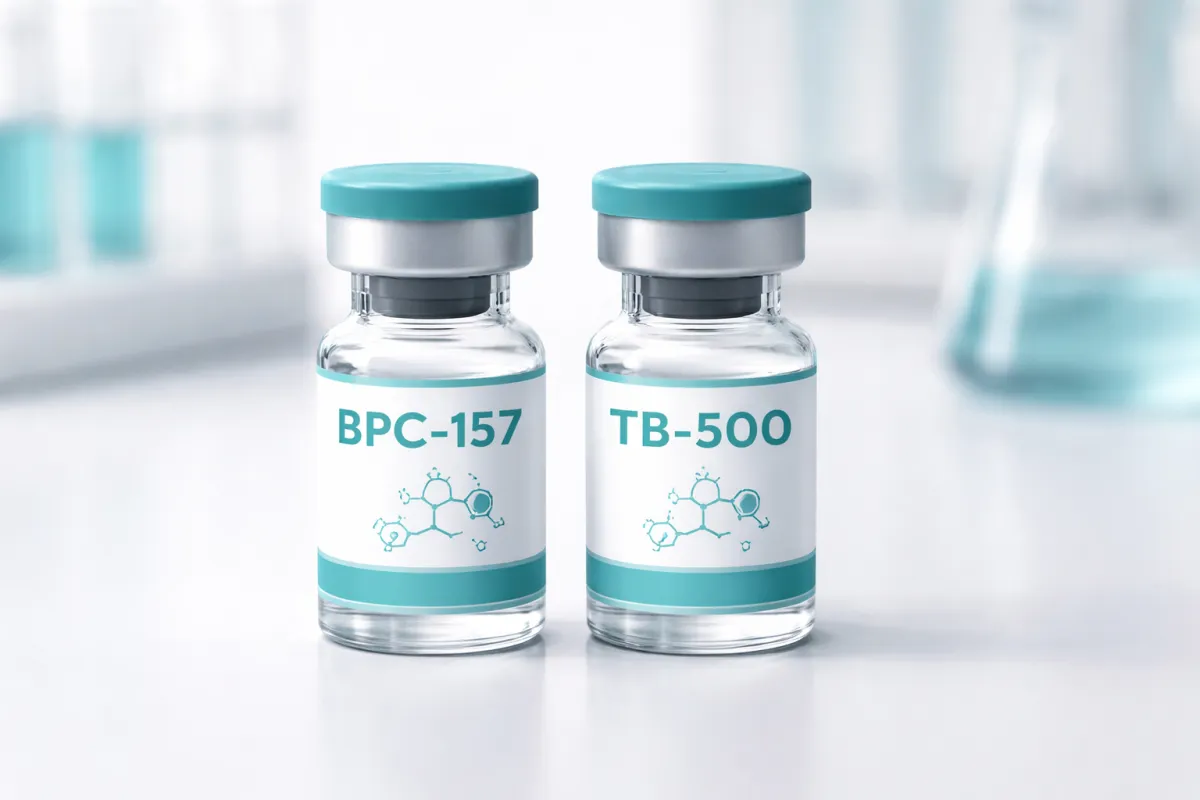
The Wolverine Stack: BPC-157 + TB-500 Complete Protocol Guide
The injury healing combination that handles 80% of soft tissue problems.
AI SUMMARY
Definition: The Wolverine Stack combines BPC-157 and TB-500, two peptides that work through complementary mechanisms to accelerate tissue repair.
Primary Use: Soft tissue injuries including tendons, ligaments, muscles, and post-surgical recovery.
Typical Timeline: Pain reduction in 1-2 weeks, structural healing improvements at 4-6 weeks, full protocol duration 6-8 weeks.
Best For: Athletes, active individuals, and anyone recovering from sprains, strains, tears, or surgery.
Not For: Those expecting overnight results or unwilling to commit to 6-8 weeks of consistent dosing.
Why Two Peptides Instead of One
Your injured tendon is like a construction site with no workers, no materials, and no roads to deliver supplies. That's why normal healing takes forever.
BPC-157 builds highways directly to the damage and recruits the repair crew. TB-500 is the project manager who coordinates everything and calls in reinforcements from across your entire body.
Running BPC-157 alone handles about 80% of minor injuries. But for moderate to severe damage, adding TB-500 creates a synergistic effect where 1+1 equals 10. Clinical experience consistently shows the combination outperforms either peptide used solo.
How Each Peptide Works
BPC-157 is your first responder:
BPC-157 (Body Protection Compound-157) is a synthetic peptide derived from a protein naturally found in gastric juice. Research published in 2025 confirms it enhances growth hormone receptor expression and multiple pathways involved in cell growth and angiogenesis while reducing inflammatory cytokines.
In practical terms, BPC-157 builds new blood vessels directly to the injury site so oxygen and nutrients can flood in. It ramps up collagen production, which is the actual building material for tendons and ligaments. It calms inflammation so swelling doesn't slow down the repair process.
BPC-157 works locally. Inject it near the injury and it concentrates its effects there.
TB-500 is your project manager:
TB-500 is a synthetic fragment of Thymosin Beta-4, a naturally occurring protein involved in actin regulation and cellular organization. It works systemically throughout your entire body rather than locally.
TB-500 sends stem cells from your bone marrow directly to the damage site. It rebuilds your cellular scaffolding (the actin cytoskeleton) from the ground up. It reduces scar tissue formation and improves tissue flexibility during healing.
The key difference: TB-500 injection site doesn't matter because it circulates throughout your system. BPC-157 injection site matters because it works where you put it.
The Synergy Effect
When combined, BPC-157 and TB-500 target both the inflammatory and regenerative phases of healing simultaneously.
BPC-157 stabilizes the vascular environment and controls inflammation. TB-500 facilitates cellular movement and structural remodeling. Together they regulate crucial growth factors including VEGF (vascular endothelial growth factor), FGF (fibroblast growth factor), and IGF-1 (insulin-like growth factor-1).
The result: accelerated recovery in tendons, ligaments, and muscle compared to using either peptide alone.
The Protocol
Standard Protocol (Most Injuries)
BPC-157:
Dose: 250-500 mcg daily
Timing: Morning, or split AM/PM for higher doses
Injection: Subcutaneous, as close to the injury as comfortable
Duration: 4-8 weeks
TB-500:
Loading phase (weeks 1-4): 2-5 mg twice weekly
Maintenance phase (weeks 5-8): 2 mg once weekly
Injection: Subcutaneous anywhere (abdomen is fine)
Duration: 6-8 weeks
Run both peptides simultaneously for the full synergistic effect.
Aggressive Protocol (Severe Injuries or Post-Surgery)
For significant trauma or post-surgical recovery, practitioners sometimes use higher doses:
BPC-157: 500 mcg twice daily (1 mg total) TB-500: 5 mg twice weekly during loading
This approach is more expensive but appropriate for serious injuries where faster recovery matters.
Reconstitution
Both peptides come as lyophilized powder. Add bacteriostatic water to reconstitute:
5mg vial + 2mL BAC water = 2.5mg/mL concentration
10mg vial + 2mL BAC water = 5mg/mL concentration
For a 5mg vial with 2mL water:
250 mcg = 10 units on insulin syringe
500 mcg = 20 units on insulin syringe
2.5 mg = 100 units (1mL)
Store reconstituted peptides in the refrigerator. Use within 4-6 weeks.
What to Expect
Week 1-2:
Inflammation begins dropping
Pain at rest decreases
Sleep may improve (less discomfort waking you up)
Week 3-4:
Noticeable improvement in range of motion
Pain during activity decreases
Swelling continues reducing
Week 5-8:
Structural healing progresses
Strength begins returning
Movement patterns normalize
Real healing takes time. The peptides accelerate the process but don't skip stages. If you tore a tendon that normally takes 12 weeks to heal, expect 6-8 weeks with the Wolverine Stack, not 2 weeks.
Injection Technique
For BPC-157 (local effect): Inject subcutaneously as close to the injury as comfortable. You don't need to inject directly into the joint or tendon. The area within a few inches works.
For shoulder injuries: upper arm or deltoid area For knee injuries: around the knee, avoiding the kneecap For back injuries: abdomen is acceptable since BPC-157 has some systemic effects
For TB-500 (systemic effect): Inject subcutaneously anywhere convenient. Most people use abdominal fat, rotating sites. The injection location doesn't affect where TB-500 works because it circulates throughout your body.
Technique:
Clean injection site with alcohol swab
Pinch skin to create a fold
Insert needle at 45-90 degree angle
Inject slowly
Withdraw and dispose of needle properly
Don't rub the site
Common Mistakes
Running BPC-157 alone for serious injuries: BPC-157 solo handles minor issues. For anything beyond a mild strain, adding TB-500 significantly improves outcomes.
Stopping too early: Feeling better at week 3 doesn't mean you're healed. Structural repair takes 6-8 weeks. Stopping early risks re-injury because the tissue isn't actually rebuilt yet.
Expecting oral peptides to work: Oral BPC-157 has some gut-specific benefits but doesn't effectively reach injured tendons, muscles, or joints. For musculoskeletal healing, injectable forms are necessary.
Injecting TB-500 locally: TB-500 is systemic. Injecting it near your injury doesn't concentrate it there. Save the local injection approach for BPC-157.
Safety Considerations
Both BPC-157 and TB-500 have demonstrated good safety profiles in preclinical research. A 2025 systematic review of BPC-157 literature found no harmful effects reported in animal studies, though human clinical safety data remains limited.
Potential side effects:
Injection site reactions (redness, minor irritation)
Headache (uncommon)
Nausea (rare)
Fatigue (usually temporary)
Contraindications:
Active cancer or history of cancer (theoretical concern with angiogenesis promotion)
Pregnancy or breastfeeding
Children under 18
Drug interactions: No significant interactions documented, but inform your healthcare provider if you're on blood thinners or immunosuppressants.
Important: Neither BPC-157 nor TB-500 is FDA-approved for human use. Both are banned by WADA and most professional sports organizations. This information is for research and educational purposes only.
Supply List for 8 Weeks
Peptides:
BPC-157: 2-3 vials (10mg each) depending on dose
TB-500: 3-4 vials (10mg each) for loading + maintenance
Supplies:
Bacteriostatic water: 20-30mL total
Insulin syringes: 50-100 (29-31 gauge, 0.5mL or 1mL)
Alcohol prep pads
Sharps container
Trusted Sources
Quality matters for injectable peptides. These suppliers provide third-party tested research compounds:
US Suppliers:
Modern Aminos (Code: zach10 for 10% off)
Optimum Formula (Code: BHACK for 10% off)
ResearchChemHQ (Code: BHACK)
Limitless Life Nootropics (Code: BHACK for 15% off)
Peptira (Code: bhack for 10% off)
BioLongevity Labs (Code: BHACK for 15% off)
Canadian Suppliers:
BioSLab (Code: BHACK for 10% off)
European Suppliers:
LimitlessBioChem (Code: BHACK for 10% off)
Pre-made blends simplify the process if you want both peptides in one vial. Individual vials allow more dosing flexibility.
Always verify third-party testing certificates before purchasing research peptides.
Frequently Asked Questions
Can I run BPC-157 without TB-500? Yes. BPC-157 alone handles most minor injuries effectively. Add TB-500 for moderate to severe injuries, chronic issues, or when you want faster results.
Can I run TB-500 without BPC-157? Yes, but this is less common. TB-500 alone is sometimes used for systemic inflammation or flexibility issues. For localized injuries, adding BPC-157 improves outcomes.
How long until I feel something? Most people notice reduced inflammation and pain within 1-2 weeks. Structural healing takes longer.
Can I use oral BPC-157 instead of injections? Oral BPC-157 may help gut issues but doesn't effectively reach musculoskeletal injuries. For tendons, ligaments, and muscles, use injectable.
Do I need to cycle off? Standard protocols run 6-8 weeks then reassess. If the injury is healed, stop. If more healing is needed, you can continue or take 2-4 weeks off then resume.
Is the Wolverine Stack the same as the Glow Stack? No. The Wolverine Stack is BPC-157 + TB-500. The Glow Stack adds GHK-Cu for enhanced collagen remodeling and aesthetic benefits.
The Bottom Line
The Wolverine Stack earned its name because it genuinely accelerates healing in ways that feel almost superhuman compared to waiting months for natural recovery.
BPC-157 handles the local repair work. TB-500 coordinates the systemic response. Together they create conditions where your body can rebuild damaged tissue faster and more completely than it would on its own.
For anyone dealing with a stubborn injury that won't resolve, recovering from surgery, or wanting to return to activity faster, this combination represents the foundation of peptide-based tissue repair.
Related Guides:
Disclaimer: This content is for educational and research purposes only. Peptides are not approved for human use. Nothing here is medical advice. Consult a qualified professional for personalized guidance.
